
In the global market for industrial automation, the “small details” often dictate whether an installation goes smoothly or results in a costly field failure. For a Limit Switch Box (Valve Position Monitor), the cable entry is the gatekeeper. It is the interface where field wiring enters the protective enclosure of the switch box.
At Zhejiang KGSY Intelligent Technology Co., Ltd., our mission is to provide universal solutions. Whether you are installing a DSK100 on a water line in Europe or an APL-210N on a refinery skid in North America, you will notice that our enclosures offer different thread standards—most notably NPT and Metric (M20).
Choosing the wrong thread can lead to stripped housings, compromised IP ratings, or even the loss of explosion-proof integrity. This guide explains the differences between these standards and how to select the right one for your KGSY equipment.
1. What is an NPT Thread? (National Pipe Taper)
NPT is the standard used primarily in the United States, Canada, and by many American-spec oil and gas companies globally. In the KGSY catalog, you will often see entries listed as 2 x NPT 1/2″.
The Taper Principle
The defining characteristic of an NPT thread is that it is tapered. As you screw an NPT cable gland into the KGSY switch box, the diameter of the thread slightly increases.
- The Seal: The seal is created by the “interference fit” between the threads themselves. As they are tightened, the metal-to-metal contact becomes tighter, creating a leak-proof bond.
- The Benefit: NPT is excellent for high-pressure environments and is the legacy standard for American explosion-proof installations.
Challenges with NPT
Because NPT relies on the thread fit for sealing, it often requires the use of thread sealant or Teflon tape to ensure a gas-tight connection. Over-tightening can crack the aluminum housing of a switch box if not handled with care.
2. What is a Metric (M20) Thread?
Metric threads (indicated by the “M” prefix, such as M20 x 1.5) are the international standard used throughout Europe, Asia, and most of the world outside North America. KGSY switch boxes frequently offer 2 x M20 x 1.5 entries as a standard option.
The Parallel Principle
Unlike NPT, Metric threads are parallel (straight). The diameter is constant from the first thread to the last.
- The Seal: Because the threads are straight, they do not create a seal on their own. Instead, a Metric cable gland relies on a shoulder seal (an O-ring or washer) that is compressed against the flat face of the KGSY switch box.
- The Benefit: Metric threads are easier to install repeatedly without damaging the housing. They provide a highly reliable IP67 or IP68 weather seal because the O-ring does all the work, rather than the metal threads.
3. Why the Choice Matters for KGSY Enclosures
At KGSY, we manufacture our housings from high-quality Die-cast Aluminum Alloy or Stainless Steel 316. The integrity of the thread is vital for two reasons:
Environmental Protection (IP Rating)
Our DSK and APL series are rated to IP67/IP68 standards. If you force a Metric gland into an NPT hole (or vice versa), you will destroy the threads. Even if it feels “tight,” the gap between the mismatched threads will allow moisture to enter. Once water is inside the box, your Gold-Plated or Silver contacts will eventually corrode, leading to signal failure.
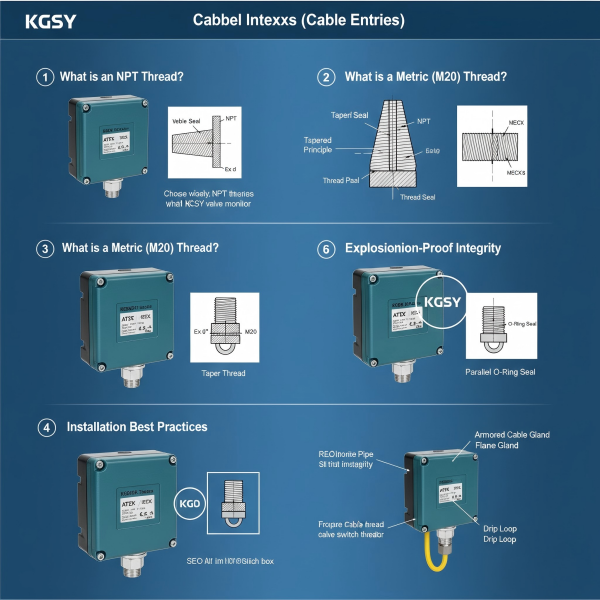
Explosion-Proof Integrity (Ex d)
For our KG800 and FC800 Series, which carry ATEX and IECEx certifications, the cable entry is part of the “flame path.” In a flameproof (Ex d) enclosure, the threads must be able to withstand the pressure of an internal explosion and cool the escaping gases.
- Thread Engagement: Safety standards require a specific number of threads (usually at least 5 full threads) to be engaged. Using the wrong thread standard makes it impossible to achieve the required safety engagement, voiding the explosion-proof certification.
4. Comparing NPT 1/2″ and M20 x 1.5
In the world of valve monitoring, these are the two most common sizes. They look remarkably similar to the naked eye, but they are not interchangeable.
| Feature | NPT 1/2″ | Metric (M20 x 1.5) |
| Shape | Tapered (1:16 ratio) | Parallel (Straight) |
| Angle of Thread | 60° | 60° |
| Sealing Method | Thread-to-thread contact | O-ring/Washer at the base |
| Common Region | North America, Oil & Gas | Europe, Asia, International |
| KGSY Standard | Optional (Common for export) | Standard / Default |
How to Identify Them
- Measurement: An M20 thread has a precise 20mm outer diameter. An NPT 1/2″ thread actually has an outer diameter closer to 21.3mm at the widest point.
- The “Feel”: A Metric gland will screw in smoothly until the O-ring hits the box. An NPT gland will start easy and become increasingly difficult to turn as the taper engages.
5. Selection Guide: Which Entry Should You Order?
When placing an order for KGSY Valve Position Monitors, use the following criteria to choose your cable entry standard:
Choose NPT (e.g., APL-210N with 2 x NPT 1/2″) if:
- Your project is located in the USA, Canada, or Mexico.
- You are using Rigid Metal Conduit (RMC) instead of flexible cables.
- Your facility uses existing American-standard cable glands.
- Your project is in Europe, China, Southeast Asia, or the Middle East.
- You are using armored or non-armored flexible cables.
- You prefer the IP68 sealing ease provided by O-ring glands.
Choose Metric (e.g., DSK100 with 2 x M20 x 1.5) if:
KGSY Customization
Can’t decide? KGSY offers multiple entry points on our larger boxes (like the ALS-400). We can provide G1/2″ (the British parallel standard) upon request as well. Our standard configuration includes two entries, allowing for “daisy-chaining”—running power in through one hole and out to the solenoid valve through the other.
6. Installation Best Practices
To ensure the longevity of your KGSY switch box, follow these professional wiring tips:
- Never Force It: If a cable gland does not turn easily by hand for the first three rotations, stop. You likely have a thread mismatch.
- Use Plugs: Every KGSY box is shipped with temporary plastic plugs. These are not for permanent use. You must replace any unused entry with a certified metal blanking plug (NPT or Metric) to maintain the IP67/Ex rating.
- The Drip Loop: Always allow the cable to hang slightly below the entry point before entering the box. This prevents rainwater from running down the cable and directly into the gland seal.
Conclusion: The Foundation of a Reliable System
A limit switch box is a precision instrument, but it relies on a secure mechanical foundation. By understanding the difference between NPT and Metric cable entries, you ensure that your KGSY device remains sealed against the environment and compliant with local safety regulations.
At Zhejiang KGSY Intelligent Technology Co., Ltd., we provide the flexibility to meet any global standard. From our SIL3 certified KG800 to our versatile APL series, we ensure that the gateway to your electrical feedback is as robust as the switches themselves.
Need a specific thread for your project?
Contact our engineering department to discuss custom thread options or blanking plug requirements.
- Website: www.chinakgsy.com
- Email: manager@zjkgsy.com
- Phone/WeChat: 086-13587661980
Post time: Feb-23-2026

