
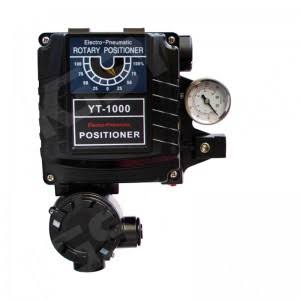
In the evolution of industrial process automation, the transition from analog mechanical control to digital plant architecture represents one of the most significant technological leaps of the last half-century. At the center of this transformation on the factory floor is the control valve assembly—and specifically, the smart digital positioner.
While classic electro-pneumatic positioners rely strictly on a 4–20mA analog current loop to govern valve stem placement, modern process facilities require deeper operational insight. This is where the HART (Highway Addressable Remote Transducer) Protocol becomes essential.
By superimposing digital communication signals directly over standard 4–20mA analog wiring, HART enables instrument engineers, maintenance teams, and procurement leads to unlock real-time predictive diagnostics, remote configuration, and online calibration—without requiring costly re-cabling or infrastructure revamps.
1. What Is the HART Protocol?
First developed in the late 1980s and maintained today by the FieldComm Group, the HART Protocol is an open, hybrid physical communication standard designed for process measurement and control.
The core genius of HART lies in its ability to combine analog reliability with digital intelligence:
+————————————————————————-+
| HART Frequency Shift Keying (FSK) |
+————————————————————————-+
| |
| Analog Signal: 4 – 20 mA DC (Primary Variable: Target Position) |
| |
| Digital Signal: Superimposed FSK AC Signals (Sine Waves) |
| * Logic “1″: 1200 Hz |
| * Logic “0″: 2200 Hz |
| |
| Net DC Average: 0 mA (No distortion to the 4-20 mA analog signal) |
+————————————————————————-+
Using the Bell 202 Frequency Shift Keying (FSK) standard, the positioner modulates low-level digital signals on top of the continuous 4–20mA analog control loop:
-
A frequency of 1200Hz represents a digital 1.
-
A frequency of 2200Hz represents a digital 0.
Because the average value of a sinusoidal FSK signal is zero, the digital data adds no net DC offset to the underlying 4–20mA current loop. The Distributed Control System (DCS) continues to read the analog signal for real-time valve control, while HART-enabled host systems simultaneously transmit and receive digital parameter data over the exact same pair of wires.
2. Key Operational Advantages of HART-Enabled Positioners
Integrating HART communication into smart digital positioners upgrades a valve assembly from a passive mechanical component into an intelligent digital node.
1. Remote Configuration and Calibration
In traditional analog setups, zero and span adjustments require maintenance technicians to physically access the valve location—often involving climbing pipe racks, wearing specialized PPE, or obtaining hot-work permits in hazardous zones.
With a HART smart positioner, technicians can perform full auto-tuning, zero adjustments, and span calibration remotely from the control room or using a portable handheld HART communicator (such as an Emerson AMS Trex or FieldComm Field Communicator) connected anywhere along the loop.
2. Multi-Variable Digital Feedback
While the traditional 4–20mA signal conveys only one piece of data (the primary control setpoint), the HART digital layer carries dozens of secondary variables, including:
-
Actual Valve Stem Position: Real-time feedback verifying physical stroke percentage.
-
Actuator Pressure Data: Dual-channel pneumatic output pressure measurements.
-
Internal Temperature: Ambient operating conditions inside the positioner housing.
-
Total Travel & Cycle Counter: Cumulative stem movement tracking to schedule mechanical packing rebuilds.
3. Predictive Diagnostics & Partial Stroke Testing (PST)
Unplanned plant shutdowns caused by stuck or degraded control valves can cost hundreds of thousands of dollars per hour. HART positioners continuously monitor internal health metrics to detect issues before catastrophic failure occurs:
-
Valve Friction Monitoring: Detects packing gland overtightening or seat galling.
-
Air Leakage Detection: Identifies torn actuator diaphragms or worn O-ring seals.
-
Emergency Shutdown (ESD) Verification via PST: For safety-instrumented valves, HART positioners execute automated Partial Stroke Testing, moving the valve stem $3\text{\% to }5\text{\%}$ to verify mechanical freedom without disturbing ongoing process production.
3. HART 5 vs. HART 7: Understanding Protocol Versions
When sourcing HART-enabled smart positioners, procurement teams frequently encounter specification requirements for HART 5 or HART 7. Understanding the differences ensures full compatibility with the existing Distributed Control System (DCS) host:
|
Technical Parameter |
HART Version 5 |
HART Version 7 |
Procurement & Engineering Impact |
|
Primary Deployment |
Legacy Plant Architecture |
Modern Digital Infrastructure |
HART 7 offers enhanced data speed & security |
|
Wireless Support |
Requires external adapters |
Native support for WirelessHART |
Wireless monitoring without running new field wire |
|
Enhanced Diagnostics |
Standard device status flags |
Advanced multi-variable timestamping |
Detailed root-cause event logging |
|
Backward Compatibility |
Industry universal baseline |
100% Backward Compatible with HART 5 hosts |
HART 7 devices drop seamlessly into HART 5 loops |
4. Mechanical & Electrical Interoperability
Beyond the digital communication protocol, a smart HART positioner must interface flawlessly with the mechanical valve package and pneumatic system.
International Mounting Geometry
High-quality independent HART positioners are designed to mount onto any standard industrial actuator:
-
Quarter-Turn Rotary Actuators: Mates via the universal NAMUR VDI/VDE 3845 mounting pad and pinion slot.
-
Linear Globe/Diaphragm Actuators: Mates via the standardized IEC 60534-6-1 pillar bracket system.
Explosion-Proof & Hazardous Area Integrity
Because smart positioners operate directly on process lines handling volatile hydrocarbons, explosive gases, or combustible dusts, their internal HART electronics and piezo-electric pilot valves are housed within certified explosion-proof enclosures:
-
ATEX / IECEx Explosion-Proof: ExdIICT6Gb for Zone 1 and Zone 21 hazardous atmospheres.
-
ATEX / IECEx Intrinsic Safety: ExiaIICT6Ga for Zone 0 energy-limited loops.
-
Environmental Protection: Hard-anodized aluminum or 316L stainless steel housings with IP66 / IP67 ingress protection.
5. Overcoming Supply Chain Bottlenecks in Smart Positioners
Historically, instrument engineers defaulted to sourcing HART smart positioners exclusively from legacy Western conglomerates (such as Emerson Fisher, Siemens, and Samson). However, global procurement teams face significant hurdles with these legacy vendors, including 16 to 26-week lead times and high unit costs.
To build supply chain resilience, forward-thinking EPC contractors and plant MRO leads are qualifying agile independent smart positioner manufacturers.
By delivering full HART protocol compliance, robust piezo-valve technology, universal NAMUR/IEC mounting brackets, and global hazardous area certifications (ATEX/IECEx/SIL), certified independent suppliers allow plants to:
-
Reduce Hardware CAPEX by 30% to 50% compared to legacy brand pricing.
-
Compress Delivery Lead Times to 2 to 4 Weeks, protecting project milestone schedules and avoiding liquidated damages.
-
Ensure 100% Direct Drop-in Fitment onto existing actuator inventory without custom bracket engineering.
6. Strategic Execution Roadmap for Instrument Engineers
To successfully specify and integrate HART-enabled positioners into your automation framework:
-
Audit DCS/PLC Input-Output Modules: Confirm whether your control system cards support digital HART passthrough or if HART multiplexers/modems are required for asset management software integration.
-
Standardize Electronic Device Description (EDD) Files: Ensure the positioner supplier provides standardized EDD and FDT/DTM drivers for seamless plug-and-play setup in systems like Emerson AMS, Siemens PDM, or Yokogawa PRM.
-
Implement Dual-Sourcing Approved Vendor Lists (AVL): Add qualified independent HART smart positioner manufacturers to your AVL to insulate upcoming plant revamps and EPC projects from legacy supply chain delays.
By demystifying the HART protocol and leveraging cost-effective, certified smart positioners, process operations safeguard their plant diagnostics, optimize maintenance workflows, and achieve total supply chain flexibility.
Post time: Nov-04-2026

