
In the realm of process automation, the 4-20mA analog current loop is the undisputed gold standard for transmitting continuous data. Unlike voltage signals (like 0-10V), which degrade over long cable runs due to voltage drop, a 4-20mA current loop remains robust and perfectly accurate over thousands of feet of wire. It is the lifeblood of continuous valve position feedback, allowing the Distributed Control System (DCS) to know exactly where a control valve is positioned between 0% (4mA) and 100% (20mA).
However, even the most robust analog signals are vulnerable to an invisible, deeply frustrating electrical ghost: The Ground Loop.
When a ground loop infects a 4-20mA circuit, the DCS screen begins to lie. A valve that is physically locked in a static 50% open position might display wild, erratic fluctuations, or the baseline “zero” might drift. At Zhejiang KGSY Intelligent Technology Co., Ltd., we engineer continuous position transmitters and smart limit switch boxes designed to deliver absolute signal integrity. Resolving signal instability requires understanding the physics of grounding and applying rigorous diagnostic protocols.
Here is a comprehensive engineering guide to identifying, diagnosing, and permanently eliminating ground loops in your valve position feedback circuits.
1. The Physics of a Ground Loop
To defeat a ground loop, you must first understand how it forms. A 4-20mA loop is designed to be a closed, isolated circuit. Current leaves the DCS output card, travels to the field transmitter (inside the limit switch box or positioner), and returns to the DCS.
A ground loop occurs when this intended circuit accidentally connects to earth ground at two or more different points.
Many engineers mistakenly assume that “Ground is Ground”—that the earth potential at the DCS marshalling cabinet is exactly 0.0V, and the earth potential at the physical valve pipeline 500 meters away is also 0.0V. In a heavy industrial plant, this is never true. Large electric motors, variable frequency drives (VFDs), and heavy machinery inject stray currents into the earth.
This creates a Potential Difference (Voltage) between Ground A (the DCS) and Ground B (the valve). If the 4-20mA signal wire or its metallic shield is grounded at both locations, this voltage difference forces a parasitic, unintended current to flow through your signal wire. This parasitic current adds to or subtracts from your true 4-20mA signal, severely distorting the DCS reading.
2. Identifying the Symptoms of a Ground Loop
Before tearing apart field wiring, observe the behavior of the DCS feedback. Ground loops produce distinct electrical signatures:
-
The “Jittery” Signal: The valve is mechanically frozen via a manual override, yet the DCS shows the position rapidly fluttering (e.g., bouncing randomly between 11.8mA and 12.5mA).
-
The Baseline Shift (Zero-Shift): The control valve is confirmed to be 100% mechanically closed. However, instead of reading a perfect 4.00mA, the loop reads a steady 4.60mA or 5.20mA. The ground loop is injecting a constant offset current.
-
Signal Clipping: The valve is fully open, but the signal maxes out at 17mA and refuses to reach 20mA, because the parasitic ground current is creating excessive voltage drop across the loop, starving the transmitter of power.
-
AC Noise Interference: Ground loops often act as antennas, picking up 50Hz or 60Hz AC noise from nearby power lines and superimposing it onto your DC control signal.
3. Common Causes in Valve Automation Installations
In field instrumentation, ground loops are almost always the result of installation errors or environmental degradation.
1. The Double-Grounded Cable Shield
This is the number one cause of industrial ground loops. High-quality instrumentation cable features a braided metal or foil shield to protect the 4-20mA signal from electromagnetic interference (EMI). If a technician connects this shield to the earth ground bar inside the DCS cabinet, and also connects the shield to the internal ground terminal inside the field limit switch box, a massive ground loop is instantly created.
2. Water Ingress and Moisture Faults
A circuit that was perfectly isolated for years can suddenly develop a ground loop after a heavy rainstorm. If rainwater or internal condensation breaches a poorly sealed limit switch box, the water can pool across the Printed Circuit Board (PCB). Water is conductive; it creates an unintended electrical bridge between the 4-20mA transmitter circuit and the grounded metal housing of the enclosure.
3. Non-Isolated Field Transmitters
Economy-grade 4-20mA transmitters often share a common ground between the sensor input and the current output. If the physical sensor touches the grounded metal of the valve mounting bracket, the entire loop becomes tied to the local pipeline ground.
4. Step-by-Step Diagnostic Protocol
When field jitter occurs, dispatch your technicians with a high-quality Digital Multimeter (DMM) and follow this isolation sequence:
Step 1: The Shield Check (Lift the Ground)
Open the limit switch box in the field (observing all hazardous area safety protocols). Inspect the signal cable shield. Is it tied to the local grounding screw? If so, disconnect it. The shield should only be grounded at one end (almost universally at the DCS cabinet) to act as a Faraday cage without conducting current.
Step 2: The Voltage Differential Test
Set the DMM to read AC/DC voltage. Place one probe on the disconnected cable shield, and the other probe on the physical metal housing of the valve/switch box. If you read a voltage (even 1 or 2 volts), you have a severe earth potential difference between the control room and the field.
Step 3: The “Battery Isolate” Test
If the source of the loop is unclear, disconnect the DCS wires completely. Power the 4-20mA field transmitter locally using two isolated 9V batteries wired in series (18VDC) and read the output with a loop calibrator or DMM. Because the batteries have zero connection to earth ground, you have perfectly isolated the circuit. If the signal instantly becomes stable and clean, a ground loop with the DCS is your confirmed culprit.
5. Engineered Solutions and Prevention
Fixing a ground loop requires breaking the galvanic path.
Best Practice Wiring
Enforce strict installation standards. Signal shields must be trimmed, taped, and insulated at the field end to ensure they cannot accidentally touch the inner metal housing of the limit switch box during vibration.
Implement Galvanic Signal Isolators
If the environment makes earth potential differences unavoidable, install a Galvanic Signal Isolator in the DCS cabinet. These devices use optical or magnetic transformers to pass the 4-20mA signal across an air gap. Because there is no physical wire connecting the input to the output, a ground loop simply cannot exist.
Specify High-Isolation Hardware
The best defense is hardware designed for harsh electrical environments. When specifying continuous position feedback, insist on equipment with built-in optical isolation.
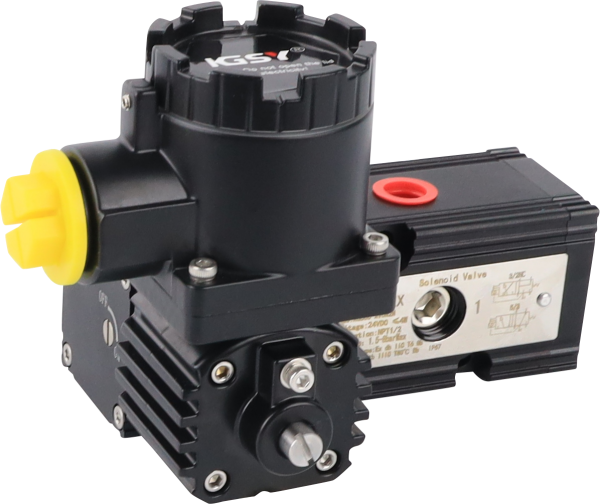
At Zhejiang KGSY Intelligent Technology Co., Ltd., we design our continuous feedback transmitters and smart switch boxes to eliminate these headaches at the hardware level. By pairing fully isolated PCB architectures with our IP67 and Ex d rated enclosures—which completely block the moisture ingress that causes parasitic grounding—we guarantee that your 4-20mA signal remains pure, stable, and completely immune to the electrical noise of the plant floor.
Conclusion
A 4-20mA ground loop is not a ghost; it is a measurable physical phenomenon caused by flawed electrical geometry. By strictly enforcing single-point shield grounding, utilizing galvanic isolators, and deploying rigorously sealed, high-isolation valve feedback components, engineers can permanently stabilize their control loops. Clean signals mean precise valve control, fewer false alarms, and maximum plant uptime.
Post time: Apr-08-2026

