
When specifying a pneumatic control system, engineers often obsess over valve flow rates (Cv values) and port sizes, but they frequently overlook a critical electrical decision: Should you use Alternating Current (AC) or Direct Current (DC)?
Selecting the wrong voltage type can lead to integration headaches, safety hazards, and premature coil burnout. At Zhejiang KGSY Intelligent Technology Co., Ltd., we manufacture a wide range of valve intelligent control accessories, including the popular 4V, 4M, and KG800 series. We offer coils in all standard industrial voltages to suit your specific infrastructure.
This guide will break down the technical differences between AC and DC solenoid valves, compare their power consumption based on KGSY specifications, and help you make the right choice for your application.
The Standard Industrial Options
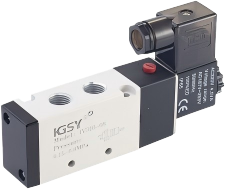
Before diving into the “AC vs. DC” debate, it is important to know what is readily available. KGSY solenoid valves are standardly equipped to handle the following global voltage standards:
-
AC Voltages: AC220V, AC110V, AC24V.
-
DC Voltages: DC24V, DC12V.
Whether you are retrofitting an old factory running on 110VAC or designing a modern 24VDC automated line, we have a coil to match.
1. AC Solenoid Valves (Alternating Current)
AC solenoid valves, typically AC220V or AC110V, are traditionally popular in heavy industry where mains power is readily available without the need for power supplies or transformers.
How They Work: The “Inrush” Current
The defining characteristic of an AC coil is the inrush current. When an AC solenoid is first energized, the impedance is low, causing a massive spike in current to generate the initial magnetic force required to pull the plunger (armature). As the plunger seals against the core, the impedance rises, and the current drops to a lower “holding level.”
Advantages of AC Coils:
-
Faster Response Time: Due to the high initial inrush current, AC valves generally shift slightly faster than DC valves. For our 4V Series, the activating time is 0.05 seconds or below.
-
Higher Pressure Handling: The initial power spike allows AC valves to overcome higher differential pressures upon opening.
Disadvantages and Risks:
-
The “Buzzing” Sound: AC valves rely on the frequency of the current (50/60Hz). If the plunger does not seat perfectly due to debris, the valve can emit a noticeable hum or buzz.
-
Burnout Risk (Stuck Plunger): This is the most critical downside. If debris or mechanical failure prevents the plunger from closing completely, the impedance never rises. The coil continues to draw the massive inrush current and will burn out quickly.
-
Incompatibility with Batteries: You cannot run AC valves directly from a battery backup system without an inverter.
KGSY Specification: AC Power Consumption
Despite the power spike, KGSY AC coils are engineered for efficiency. Our standard AC coils consume approximately 4.5VA to 5.0VA.
2. DC Solenoid Valves (Direct Current)
DC24V has become the gold standard for modern industrial automation, particularly in PLC (Programmable Logic Controller) environments.
How They Work: Constant Current
DC coils do not have an inrush current spike. The current draw is determined solely by the resistance of the copper wire, which remains constant (dependent only on temperature). The magnetic force builds up slightly slower than in AC coils, but provides a steady, quiet hold.
Advantages of DC Coils:
-
No Burnout from Jamming: If the valve plunger gets stuck and cannot close, the current does not increase. The coil will not burn out simply because the valve is mechanically jammed. This makes DC valves significantly more durable in dirty air environments.
-
PLC Compatibility: Most modern control systems (PLCs) operate on 24VDC. Using DC valves eliminates the need for interposing relays.
-
Safety: DC24V and DC12V are “Low Voltage,” significantly reducing the risk of electrical shock to maintenance personnel compared to AC220V.
-
Quiet Operation: DC coils produce no magnetic hum.
KGSY Specification: DC Power Consumption
Our DC coils are highly energy-efficient, generating less heat than many competitors.
-
Standard DC Power: 3.0W.
-
Low Power Option: Some models utilize as little as 2.5W.
3. Voltage Tolerance: Dealing with Fluctuations
Industrial power supplies are rarely perfect. Voltage drops over long cable runs or spikes from heavy machinery starting up can affect valve performance.
When choosing between AC and DC, consider the stability of your power grid. KGSY coils are manufactured with generous tolerance ranges to ensure reliability:
-
AC Voltage Tolerance: ±15%. (e.g., An AC220V coil can handle significant fluctuations).
-
DC Voltage Tolerance: ±10%.
If your facility has very unstable power that swings wildly, the wider tolerance of AC coils might offer a slight advantage, though a regulated DC power supply is generally the superior engineering solution.
4. Specific Applications: Explosion-Proof Environments
In hazardous environments like oil, gas, and chemical processing, voltage selection often comes down to the available certified infrastructure.
The KGSY KG800 and FC800 Series are our premium explosion-proof lines, carrying SIL3, CE, ATEX, and IECEx certifications. For these specialized valves, we offer specific voltage codes to simplify ordering:
-
V0: 24VDC
-
V1: 110VAC
-
V2: 220VAC
When designing Intrinsically Safe (IS) circuits for explosion-proof zones (Ex ia), DC voltage is almost exclusively used because it allows for limiting energy levels to prevent sparks.
Summary: Which Voltage Should You Choose?
Use the following checklist to make your final decision:
Choose 24VDC (Recommended for Modern Systems) if:
-
You are using a PLC: Direct integration simplifies wiring.
-
Safety is a priority: Eliminates shock hazards.
-
Reliability is key: You want to avoid coil burnout if the valve jams.
-
Battery Backup: You need the system to run on batteries (UPS).
Choose AC110V/220V if:
-
Retrofitting: You are replacing a valve in an old machine wired for AC.
-
Distance: The valve is located extremely far from the power source (AC transmits better over long distances with less voltage drop).
-
Speed: You require the absolute fastest possible actuation time (milliseconds matter).
Quality You Can Trust
Regardless of the voltage you choose, the quality of the coil construction determines the valve’s lifespan. KGSY coils feature Class B temperature classification and are encapsulated to meet IP66 or even IP67 standards for weatherproof applications.
Need help specifying your system?
Our engineering team can assist you in selecting the perfect voltage and valve series, from the versatile 4V Series to the robust KG800 Series.
-
Website: www.chinakgsy.com
-
Email: manager@zjkgsy.com
Phone/WeChat: 086-13587661980
Post time: Jan-21-2026

