
In the automated process industries—whether Oil & Gas, Water Treatment, or Chemical Processing—the reliability of a valve feedback system is non-negotiable. The Limit Switch Box (Valve Position Monitor) acts as the “eyes” of the control system, confirming whether a pneumatic actuator is in the open or closed position.
At Zhejiang KGSY Intelligent Technology Co., Ltd., we manufacture thousands of these units annually. One of the most common questions our engineering team receives is: “Should I choose standard mechanical switches or upgrade to inductive proximity sensors?”
While the housing of our switch boxes (like the robust APL or ALS series) provides IP67 protection for both, the technology inside the box determines the system’s lifespan, maintenance cycle, and suitability for hazardous environments. This guide breaks down the technical differences, focusing specifically on longevity and reliability.
The Contender 1: Mechanical Micro Switches
(The Industry Standard)
The mechanical micro switch (typically SPDT - Single Pole Double Throw) has been the backbone of valve automation for decades. You will find these in our standard APL-210N and DSK100 series.
How It Works
A mechanical switch relies on physical contact. Inside the KGSY switch box, a cam attached to the actuator shaft rotates. At 0° or 90°, the cam physically pushes a lever or button on the switch body. This mechanical force snaps a spring-loaded contact inside, closing the electrical circuit.
Common Brands We Use: Omron (V-15 Series), Honeywell, Cherry.
Typical Rating: 16A @ 250VAC.
The Longevity Factor: Mechanical Wear
While reliable and cost-effective, mechanical switches have a finite life defined by physics:
- Mechanical Fatigue: The internal spring and the external lever are moving parts. Every time the valve cycles, they stress. Over millions of cycles, metal fatigue sets in.
- Contact Burn (Arcing): When switching high voltages (110V/220V), a tiny electrical arc forms just before the contacts touch. Over time, this causes pitting and carbon buildup (oxidation) on the contact surface, eventually leading to signal failure.
- Vibration Sensitivity: In high-vibration applications (e.g., near pumps or compressors), the physical contacts of a mechanical switch can “bounce” or chatter, sending false signals to the PLC.
Estimated Life: Typically 5 to 10 million mechanical cycles, but significantly less under heavy electrical loads.
The Contender 2: Inductive Proximity Sensors
(The Modern Solution)
Inductive proximity sensors represent a “Solid State” technology. They are standard in our APL-220, ALS-400, and the explosion-proof KG800-Ex series.
How It Works
Inductive sensors utilize the principles of electromagnetism. The sensor face generates a high-frequency electromagnetic field. When a metal target (in our case, the KGSY cam equipped with a metal target) enters this field, it induces eddy currents in the metal, dampening the sensor’s oscillation amplitude. The sensor detects this change and triggers the output signal.
Crucial Difference: There is zero physical contact between the cam and the sensor.
Common Brands We Use: Pepperl+Fuchs (P&F NJ2-V3-N), Autonics, and high-quality KGSY proprietary sensors.
Typical Rating: 10-30VDC (PNP/NPN) or 8VDC (NAMUR).
The Longevity Factor: Infinite Durability?
Because there is no physical contact and no moving parts inside the sensor, wear and tear are virtually eliminated.
- No Mechanical Wear: You can cycle the valve 50 million times, and the sensor will not degrade physically.
- Hermetically Sealed: The internal electronics are epoxy-potted, making them impervious to moisture, dust, and corrosion—a common killer of open mechanical contacts.
- Vibration Immunity: Because there are no springs or levers to bounce, inductive sensors provide a rock-solid signal even on vibrating pipelines.
Estimated Life: Theoretically infinite, limited only by the electronic components’ aging (often exceeding 20+ years).
Head-to-Head Comparison: KGSY Field Data
When choosing a configuration for your KGSY Valve Monitor, consider these four critical dimensions of longevity:
1. Cycle Life (High Frequency Applications)
If your valve operates once a month (e.g., an isolation valve), a Mechanical Switch (APL-210) is perfectly adequate and cost-effective.
However, for process control valves that might cycle every few minutes, mechanical switches will eventually fail. Inductive Sensors are the only logical choice for high-cycle applications. They do not suffer from “contact bounce” and maintain precision over millions of operations.
2. Environmental Corrosion
In wastewater or chemical plants, corrosive gases can penetrate the switch housing.
- Mechanical: If the silver contacts oxidize (tarnish), low-voltage signals (24VDC) cannot pass through the corrosion layer (the “Dry Circuit” problem).
- Inductive: The sensing face is plastic/resin and completely sealed (IP68). There are no exposed contacts to corrode.
3. Electrical Safety & Explosion Proofing
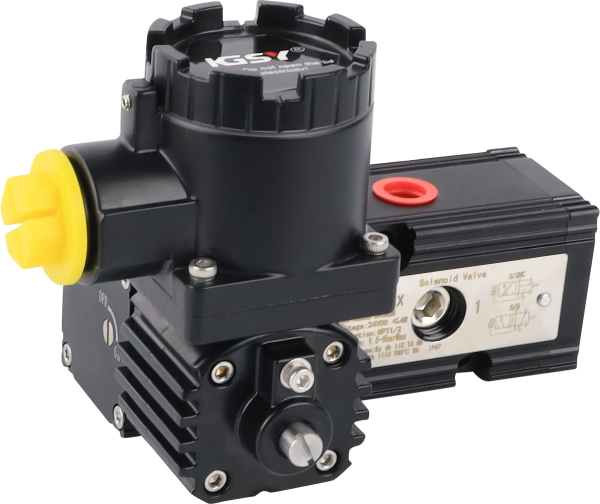
This is where KGSY’s KG800 and FC800 Series shine.
In hazardous environments (Zone 1 & 2), we often use NAMUR sensors (like the P&F NC/NO). These are a specific type of inductive sensor designed for Intrinsic Safety (Ex ia).
- They operate at very low voltage (<8.2V).
- They limit energy to prevent sparks.
- Mechanical switches can be used in Ex d (Flameproof) boxes, but for Ex ia (Intrinsic Safety), Inductive NAMUR sensors are the global standard for safety and longevity.
4. Hysteresis and Accuracy
Mechanical switches have “travel differential”—the lever must move a certain distance to reset. Over time, as the lever wears, the switch point can drift, requiring recalibration of the cams.
Inductive sensors have very precise, repeatable switching points (Hysteresis < 5%). Once you set the KGSY Splined Cam, it stays accurate forever.
Cost Benefit Analysis: Is the Upgrade Worth It?
Engineers often hesitate because Inductive Sensors are more expensive than Mechanical Switches.
- Mechanical (APL-210): Lower upfront cost. Ideal for standard, non-critical utilities.
- Inductive (APL-220 / ALS-400): Higher upfront cost (sensor + potential need for an isolation barrier in the cabinet).
The “Total Cost of Ownership” Reality:
A single failure of a mechanical switch in a critical line causes downtime. If a technician has to enter a hazardous zone to replace a $10 switch, the permit cost, downtime cost, and safety risk far exceed the $50 price difference of upgrading to a sensor initially.
Recommendation: For any critical process, high-cycle valve, or hazardous area, the Inductive Sensor pays for itself by eliminating maintenance.
KGSY Options: Tailoring Your Choice
At Zhejiang KGSY, we offer complete flexibility. Our housings are modular, meaning you can choose the exterior protection level and the interior technology that fits your budget.
| Series | Recommended Sensor/Switch Configuration | Best Application |
| APL-210 | 2 x SPDT Mechanical (Omron) | Water, HVAC, General Industry |
| APL-220 | 2 x Inductive Proximity (Autonics/P&F) | Automated Production Lines |
| ALS-400 | 2 x Inductive (3-wire PNP/NPN) | Heavy Chemical, Outdoor |
| KG800 | 2 x NAMUR Sensor (P&F NJ2-V3-N) | Explosion Proof (Oil & Gas) |
| DSK Series | Any Configuration | Premium Visual Indication |
Conclusion
The battle between Inductive Proximity Sensors and Mechanical Micro Switches isn’t about one being “bad” and the other “good.” It is about application suitability.
- Choose Mechanical for: Low cycle rates, high voltage (110/220V) direct switching, and budget-sensitive projects.
- Choose Inductive for: High reliability, low voltage (24VDC/PLC), hazardous areas, and applications where you want to “install it and forget it.”
As a manufacturer committed to “Quality is Credibility,” KGSY ensures that whether you choose the mechanical click or the inductive sensing field, the housing and assembly quality remains world-class.
Need help selecting the right sensor for your actuator?
Consult our technical catalog or contact our engineering team directly.
- Website: www.chinakgsy.com
- Email: manager@zjkgsy.com
- Tel: 086-13587661980
Post time: Feb-03-2026

