
In the rapidly evolving landscape of industrial process control, the prevailing trend is toward doing more with less. Plant managers and piping designers are constantly under pressure to reduce the physical footprint of their equipment, cut down on installation labor, and minimize ongoing maintenance costs. In the realm of automated control valves, these demands have collided with a historical engineering problem: the “Christmas Tree” effect.
Traditionally, achieving precise proportional flow control while simultaneously sending digital open/close confirmation back to the Distributed Control System (DCS) required stacking multiple individual components on top of a single pneumatic actuator. You needed an electropneumatic positioner to handle the 4-20mA control signal, and then you had to mount a separate limit switch box on top of that positioner to handle the discrete feedback.
At Zhejiang KGSY Intelligent Technology Co., Ltd., we recognized that this stacked architecture was inherently inefficient. It consumed valuable space, doubled the wiring requirements, and created mechanical vulnerabilities. The solution to this compounding complexity is the ITS-100 Integrated Positioner and Monitor—a single, elegantly engineered device that seamlessly merges highly accurate proportional control with robust position feedback.
Here is a comprehensive engineering breakdown of how the ITS-100 series is revolutionizing valve automation by drastically saving space, cutting wiring costs, and improving overall loop reliability.
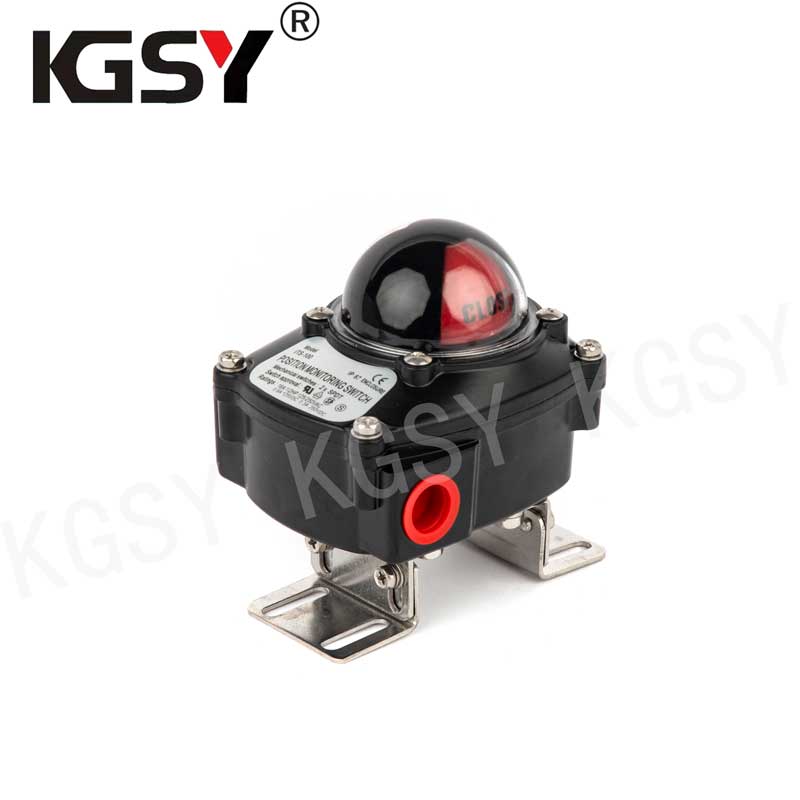
1. Eliminating the “Christmas Tree” Stack
To understand the value of the ITS-100, we must first examine the physical drawbacks of the traditional component stack. When you mount a limit switch box on top of a valve positioner, you significantly increase the overall height and weight of the automated valve package.
- The Center of Gravity Problem: In environments with heavy pipeline vibration (such as near large centrifugal pumps or compressors), a tall, top-heavy instrument stack acts like an inverted pendulum. The vibration is amplified at the top of the stack, placing immense mechanical stress on the custom mounting brackets. Over time, this leads to bracket fatigue, loosened fasteners, and eventual signal failure.
- Complex Linkages: Stacking devices requires extended shafts or secondary mechanical linkages to transfer the rotary motion of the actuator through the positioner and up into the switch box. Every additional mechanical connection is a potential point of wear, hysteresis (play), and failure.
The ITS-100 Space-Saving Advantage:
The ITS-100 eliminates the stack entirely. By housing the electropneumatic control module and the feedback micro-switches within a single, low-profile die-cast aluminum enclosure, the height of the instrument package is cut nearly in half. The center of gravity is lowered drastically, coupling the device tight to the actuator’s VDI/VDE 3845 (NAMUR) mounting pad. This compact integration makes the automated valve practically immune to vibration-induced bracket failure.
Furthermore, this extreme space savings is a massive advantage for OEM skid builders, pharmaceutical cleanrooms, and offshore platforms where physical space in piping galleys is at an absolute premium.
2. Slashing Wiring and Installation Costs
The physical dimensions are only half the story. The most significant financial savings realized by implementing the ITS-100 come during the electrical installation and commissioning phases.
In a traditional two-device setup, the field wiring is highly redundant and labor-intensive:
- The electrical contractor must pull a shielded cable for the 4-20mA analog control signal to the positioner.
- They must pull a separate multi-core cable to the limit switch box for the digital feedback (or 4-20mA output).
- This requires two separate conduit runs, two sets of expensive explosion-proof or IP67 cable glands, and double the labor hours for wire stripping, termination, and tagging.
The ITS-100 Wiring Advantage:
The ITS-100 consolidates the entire electrical interface. Both the incoming 4-20mA control signal and the outgoing position feedback signals are routed through a single, shared conduit entry into a unified, high-density terminal block.
- Reduced Copper: You significantly reduce the total length of copper wire and physical conduit required for the loop.
- Fewer Ingress Points: Every cable gland on an instrument is a potential pathway for moisture ingress. By reducing the number of electrical entries from three or four down to just one or two, you mathematically cut the risk of water damage to the internal electronics in half.
- Accelerated Commissioning: Field technicians only need to open one enclosure cover to wire the entire control and monitoring loop. This dramatically reduces the time spent on scaffolding or ladders, accelerating plant startup schedules.
3. Uncompromised Technical Performance
Integration often implies compromise—but not with the ITS-100. KGSY engineered this unit to perform at the highest level of industrial expectations, ensuring that combining two devices into one does not dilute the performance of either.
- Precision Electropneumatic Control: At its core, the ITS-100 features a highly responsive spool valve and I/P (current-to-pressure) converter. It reacts instantly to changes in the DCS control signal, providing smooth, highly accurate proportional positioning of the actuator without hunting or overshoot.
- Robust Feedback Options: The integrated monitoring section can be equipped precisely to your site’s specifications. It typically features standard SPDT mechanical micro-switches for heavy-duty load switching, but can easily be outfitted with NAMUR inductive proximity sensors for non-contact, infinite-lifecycle feedback in high-cycle applications.
- Visual Indication: Despite its compact size, the ITS-100 retains the critical 3D high-visibility position indicator dome on top, allowing operators to visually verify valve status from across the plant floor without relying on a screen.
4. Simplifying Maintenance and Calibration
A hidden cost of the traditional stacked architecture is the nightmare of calibration. When a technician needs to adjust the zero and span of the positioner, they often have to remove or work around the limit switch box mounted on top of it. Adjusting the limit switch cams might inadvertently bump the positioner linkage. The two devices constantly get in each other’s way.
The ITS-100 turns a frustrating, multi-step chore into a streamlined process. Because both the control and monitoring mechanisms share the same internal cavity and the same primary rotating shaft, everything is calibrated from a single access point.
- Remove the primary cover.
- Set the pneumatic zero and span for the control valve.
- Directly adjust the splined, spring-loaded cams for the digital feedback using the exact same shaft position.
- Replace the cover, and the loop is fully commissioned.
This single-point access significantly reduces the Mean Time To Repair (MTTR) and gets critical process lines back online faster.
Conclusion: The Smart Choice for Modern Plants
In industrial automation, complexity is the enemy of reliability. Every extra bracket, every extra wire, and every extra enclosure is a potential point of failure that costs money to install and even more money to maintain.
The ITS-100 Integrated Positioner/Monitor represents the ultimate consolidation of control and feedback. By eliminating the cumbersome “Christmas Tree” stack, cutting wiring requirements in half, and providing a single, robust, low-profile housing, it drastically lowers the Total Cost of Ownership (TCO) for automated valve packages.
It is the smartest, most efficient way to achieve proportional control with absolute feedback certainty. We invite you to experience the compact design and rock-solid engineering of the ITS-100—alongside our complete range of premium valve automation hardware—in person at CHEMUK 2026 at the NEC in Birmingham this May 20-21. Come see how KGSY is engineering a more reliable, more efficient future for process control.
Post time: Apr-29-2026

