
In the global industrial landscape, there is no environment more punishing to automated hardware than the offshore and marine sectors. Whether installed on floating production storage and offloading (FPSO) vessels, offshore drilling rigs in the North Sea, container ships, or coastal chemical terminals, valve automation packages operate in a state of constant environmental warfare.
These assets are bombarded by highly corrosive saltwater spray, subjected to relentless ultraviolet (UV) radiation, exposed to severe mechanical washdowns, and threatened by temporary or continuous submersion under heavy waves. Within this hostile landscape, the limit switch box—the critical device sending real-time open/closed feedback to the Distributed Control System (DCS)—stands as a primary target for environmental failure.
To prevent catastrophic signal loss, expensive maintenance turnarounds, and safety risks, marine and offshore engineers cannot rely on standard general-purpose instrumentation. They must specify IP68-rated and C5-M coated switch boxes.
This comprehensive technical guide explores the harsh physics of marine corrosion, the engineering differences between IP67 and IP68 protection, and how Zhejiang KGSY Intelligent Technology Co., Ltd. designs its heavy-duty position monitors to survive the world’s most aggressive marine environments.
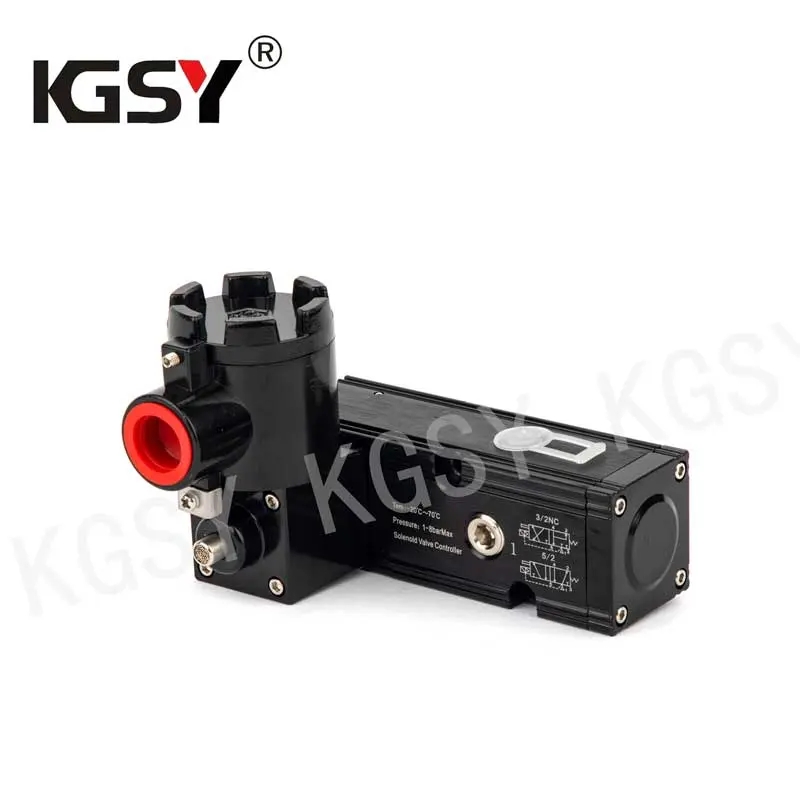
1. The Marine Gauntlet: Why Saltwater is Lethal to Electronics
To understand the necessity of specialized marine-grade hardware, we must examine the chemical and physical degradation mechanisms unique to offshore assets.
High-Salinity Electrolytes
Seawater contains a high concentration of sodium chloride (), which acts as a highly efficient electrolyte. When saltwater bridges two dissimilar metals (such as an aluminum housing and a steel mounting bolt), it initiates rapid galvanic corrosion. The less noble metal sacrifices itself, disintegrating into powdery oxides and seizing the fasteners.
Chloride-Induced Pitting
Chlorides aggressively attack the protective oxide layers of standard metals. Once the surface is breached, microscopic “pits” form. These pits act as localized stress concentrators, boring deep into the enclosure walls until the seal is compromised.
Dynamic Wave Submersion and Thermal Inhaling
During heavy seas, equipment installed on the open deck is frequently battered by crashing waves, subjecting the seals to sudden, high-pressure water impacts. Furthermore, as the temperature drops rapidly at night, the air inside a warm switch box contracts, creating a vacuum that actively “inhales” moisture-laden salt air through any microscopic seal imperfections.
If this salty moisture breaches the enclosure, it causes immediate corrosion of the copper Printed Circuit Board (PCB) traces and oxidizes the silver contacts of the micro-switches, permanently blinding the control room.
2. Decoding Ingress Protection: Why IP67 is Not Enough for Offshore Service
Many engineers assume that a standard IP67 rating is sufficient for outdoor installations. While IP67 is excellent for standard onshore plants, it is a dangerous compromise on offshore platforms.
The Ingress Protection (IP) standard (IEC 60529) defines the distinct performance gap between these two ratings:
- ● IP67 (Temporary Immersion): Specifies that the enclosure can prevent water ingress when submerged in water up to deep for a maximum of . It is designed to survive accidental drops or brief flooding events.
- ● IP68 (Continuous Immersion under Pressure): Specifies that the enclosure is dust-tight and can withstand continuous submersion in water under specified pressure conditions (typically up to or more, indefinitely).
[Image comparing IP67 temporary immersion testing vs IP68 continuous submersion testing standards]
The KGSY IP68 Solution
At KGSY, our heavy-duty series, including the ALS-500 and KG800 series, can be engineered to meet strict IP68 specifications.
To achieve this absolute seal, we utilize a redundant, high-compression dual-groove sealing system with premium Viton (FKM) or FDA-compliant Silicone O-rings. Unlike standard Nitrile rubber, which degrades under UV exposure and ozone attack, Viton retains its elasticity across extreme temperature ranges ( to ), ensuring the continuous pressure seal remains unbroken even after years of offshore service.
3. The Science of C5-M Corrosion Protection (ISO 12944)
An IP68 seal is only as good as the metal housing protecting it. If the outer shell corrodes and pits, the seal will eventually collapse. To prevent this, marine equipment must comply with the ISO 12944 standard, which classifies environments based on corrosivity.
The highest atmospheric classification is C5-M (Marine / Offshore), defined as coastal and offshore areas with high salinity, high humidity, and aggressive industrial atmospheres.
[Image of ISO 12944 atmospheric corrosivity classification chart highlighting C5-M marine rating]
KGSY’s Multi-Layer C5-M Protective Coating
Standard wet paint will blister and peel within months on an offshore rig. Zhejiang KGSY defends its copper-free aluminum housings using a specialized C5-M compliant multi-layer coating system:
1. Chemical Pre-treatment (Chromation): The raw die-cast aluminum housing undergoes an intensive acid wash and chromate conversion process. This molecularly alters the surface, creating an ultra-dense, corrosion-resistant base layer.
2. Epoxy Primer Base: A high-build epoxy primer is electrostatically applied and baked. This primer acts as a robust barrier, blocking moisture and chemical ions from touching the aluminum base.
3. Polyester Powder Topcoat: The final layer is a high-durability, baked-on polyester powder coat. This layer provides exceptional impact resistance, blocks UV radiation from degrading the underlying epoxy, and resists the aggressive chemical washdowns common on marine vessels.
With a total dry film thickness (DFT) exceeding , KGSY’s C5-M coating ensures that our aluminum housings comfortably pass the mandatory continuous salt spray test, ensuring decades of physical integrity on the open sea.
4. Metallurgical Defense: Upgrading to 316L Stainless Steel
For assets located in “splash zones”—where the equipment is continuously drenched in seawater and subjected to physical impact—even the best coatings can be scratched by tools or heavy chains. Once a coating is scored, galvanic corrosion will attack the underlying aluminum.
For these extreme severe-service zones, KGSY offers the ultimate metallurgical defense: enclosures, NAMUR mounting brackets, and captive fasteners fabricated entirely from 316L Stainless Steel.
The low-carbon chemistry of 316L stainless steel, enriched with molybdenum, provides complete immunity to atmospheric saltwater corrosion, eliminating the risk of pitting and crevice corrosion. A 316L KGSY switch box requires zero painting, zero coating maintenance, and represents a true “install-it-and-forget-it” asset for marine operators.
5. Critical Installation Guidelines for Marine Applications
Even the most advanced IP68, C5-M rated switch box will fail if the field installation is flawed. Marine electrical crews must adhere to strict wiring protocols:
- ● Incorporate Drip Loops: Always bend incoming cables into a distinct U-shape immediately before they enter the cable glands. This ensures gravity forces running water to pool and drip off at the bottom of the loop, preventing water from forcing its way past the cable gland seal.
- ● Specify SS316 Cable Glands: Never use standard nickel-plated brass glands, which tarnish and fail under marine exposure. Specify Ex d rated, 316 stainless steel cable glands equipped with Viton compression seals.
- ● Maintain Equipotential Bonding: Utilize the dual grounding points (internal and external) built into every KGSY enclosure. Properly bonding the switch box to the vessel’s steel hull prevents static buildup and mitigates galvanic loop currents.
[Image of correct marine installation showing drip loop, stainless steel cable glands, and external grounding]
Conclusion
In the offshore oil, gas, and marine industries, equipment failure is not just an inconvenience; it is a massive financial and environmental risk. By moving away from general-purpose hardware in favor of IP68-rated, C5-M coated, or 316L stainless steel enclosures, operators can permanently eliminate water ingress, signal drift, and galvanic corrosion from their failure logs.
At Zhejiang KGSY Intelligent Technology Co., Ltd., we believe that “Quality is Credibility.” Our ALS and KG800 series position monitors are engineered specifically to handle the relentless marine gauntlet. By combining robust metallurgy, FDA-compliant elastomers, and precision C5-M surface treatments, KGSY helps you secure your process, protect your offshore assets, and deliver reliable, continuous automation feedback across the oceans of the world.
Post time: May-27-2026

