
In the high-stakes environments of oil refineries, offshore drilling platforms, chemical synthesis plants, and liquefied natural gas (LNG) terminals, safety is not merely an operational metric—it is a matter of survival. These facilities process highly volatile, flammable, and toxic fluids under extreme pressures and temperatures. When a process deviation occurs—such as a sudden pressure spike, a thermal runaway, or a pipe rupture—catastrophe is prevented by a dedicated, automated layer of defense: the Emergency Shutdown System (ESD).
An ESD system is part of a broader Safety Instrumented System (SIS) designed to take the plant to a safe state when predetermined limits are exceeded. The final, critical action of any ESD loop relies on the physical closure (or opening) of massive Emergency Isolation Valves (EIVs).
However, in the logic of safety automation, commanding a valve to close is not enough. The safety PLC must receive absolute, real-time verification that the valve has physically completed its safety stroke. This vital verification relies entirely on valve position monitors (limit switch boxes).
This comprehensive technical guide explores the critical role of limit switches in ESD loops, the math of safety reliability, and how Zhejiang KGSY Intelligent Technology Co., Ltd. designs its heavy-duty position monitors to meet the fail-safe demands of global safety systems.
1. The Anatomy of an ESD Loop: The Final Control Element
A Safety Instrumented Function (SIF) within an ESD system operates on a simple three-part architecture:
- The Sensor: Detects the hazard (e.g., a pressure transmitter sensing an overpressure condition).
- The Logic Solver: A safety-certified PLC that processes the sensor data and decides if an emergency shutdown is required.
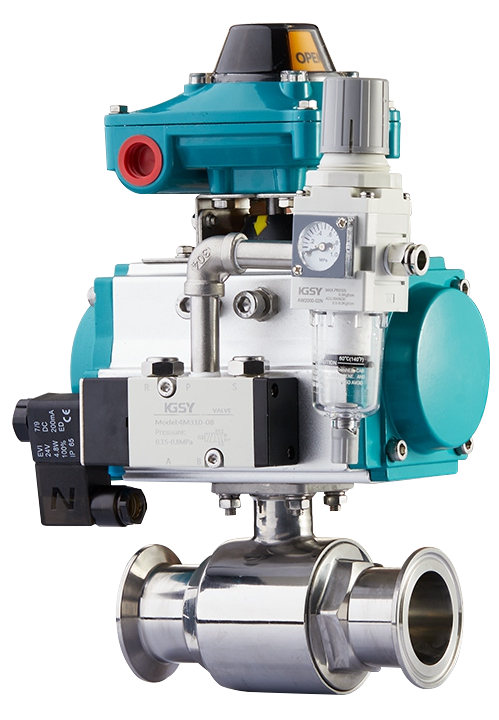
- The Final Control Element: The physical hardware that executes the shutdown. This is typically a pneumatic spring-return actuator mated to a high-performance ball or butterfly valve, overseen by a limit switch box.
[SENSORS]  ──>  [SAFETY PLC (Logic Solver)]  ──>  [ESD VALVE ASSEMBLY (Final Control)]
                                                        │ (Real-Time Feedback)
                                                  [KGSY LIMIT SWITCH BOX] ──┘
If the safety PLC commands the solenoid valve to vent pneumatic air—forcing the actuator’s heavy springs to slam the valve shut—the loop is still incomplete until the limit switch box sends a digital confirmation back to the PLC.
Without this feedback, the safety loop operates in a blind spot. If the valve stem shears, or if a mechanical obstruction jams the valve ball mid-stroke, the control room remains unaware of the failure, potentially allowing hazardous media to continue fueling a disaster.
2. Preventing “Silent Failures” and Managing $PFD_{avg}$
In safety engineering, the reliability of a safety instrumented function is measured by its Safety Integrity Level (SIL), classified from SIL 1 to SIL 4 per the IEC 61508 and IEC 61511 standards. The SIL level is determined by calculating the Average Probability of Failure on Demand ($PFD_{avg}$):
$$PFD_{avg} \approx \frac{\lambda_D \times TI}{2}$$
Where:
- $\lambda_D$ is the dangerous undetected failure rate of the component.
- $TI$ is the test interval (the time between physical proof tests).
ESD valves represent a unique engineering challenge because they suffer from “Silent Failures.” An ESD valve sits statically in the open position for months or even years without moving. During this long period of inactivity, the valve can suffer from “stiction”—where polymer seals degrade, or chemical scale crystallizes around the valve ball, effectively seizing the valve in place.
If a limit switch box suffers from internal corrosion or mechanical drift during this static period, it constitutes a dangerous undetected failure ($\lambda_D$). If an emergency occurs, the switch box may fail to report a jammed valve, preventing the safety PLC from triggering secondary safety layers.
3. The Role of Limit Switches in Partial Stroke Testing (PST)
To reduce the $PFD_{avg}$ of an ESD valve without shutting down the active process line, modern plants implement Partial Stroke Testing (PST).
During a PST, the safety PLC commands the ESD valve to close partially (typically only $10\%$ to $20\%$ of its full stroke) before returning it to the fully open position. This brief movement verifies that the valve stem is not seized, the actuator springs are healthy, and the solenoid valve can successfully vent air.
The Role of the Switch Box in PST:
Highly precise position monitors are essential for executing a safe PST.
- Preventing Over-Travel: If the valve strokes too far during a test (e.g., closing $30\%$ or more), it can restrict process flow, cause a pressure drop, and trigger an accidental plant shutdown.
- Dual-Limit and Analog Verification: Advanced KGSY position monitors can be equipped with auxiliary limit switches or integrated 4-20mA position transmitters (such as the ITS-100 series). These components provide exact positional feedback to the safety PLC, confirming that the valve stroked to exactly $15\%$ and successfully returned to $100\%$ open, validating the test automatically.
4. Critical Specifications for ESD Limit Switch Boxes
Standard, off-the-shelf limit switch boxes are a liability in an ESD loop. To ensure the safety loop remains unbroken, engineers must specify hardware built to severe-service standards.
A. SIL 2 and SIL 3 Certification
Every component in an ESD loop must be certified for use in safety-critical systems. KGSY’s heavy-duty series, including the ALS-500 and KG800 series, undergo rigorous third-party testing to achieve SIL 2 (single device) and SIL 3 (redundant configuration) certifications. This ensures that the probability of the switch box failing to send a signal during an emergency is mathematically minimized.
B. Gold-Plated Contacts for Low-Current Reliability
Traditional mechanical micro-switches utilize silver contacts. If a switch sits statically for years in a humid, corrosive atmosphere, a microscopic layer of silver oxide builds up on the contacts. This oxide acts as an insulator. Because ESD feedback loops typically run on very low current (24VDC PLC inputs, often $< 10\text{ mA}$), the low voltage cannot break through this oxide barrier, leading to a false “open circuit” signal to the PLC.
- KGSY Solution: For all safety-critical ESD loops, KGSY utilizes micro-switches with Gold-Plated Contacts. Gold does not tarnish or oxidize, guaranteeing electrical continuity even after decades of static inactivity in highly corrosive coastal or chemical environments.
C. Explosion-Proof (Ex d) Enclosures
Because ESD valves are often located directly at the source of potential gas leaks (hydrocarbon piping, manifold skids), the position monitor must be explosion-proof. KGSY’s KG800 series features thick-walled copper-free aluminum or 316L stainless steel housings certified to Ex d IIC T6. These flameproof enclosures are designed to contain any internal electrical spark, ensuring that a micro-switch actuation during an emergency shutdown cannot trigger an external explosion.
5. Eliminating Mechanical Drift: The KGSY Advantage
In high-vibration piping loops (such as compressor discharge lines), standard limit switch boxes frequently fail due to “set-screw slip.” If the internal cams are held to the shaft by tiny set-screws, the vibration can cause them to loosen. The valve closes, but the loose cam fails to strike the switch.
KGSY engineered out this failure mode entirely. Our ALS and KG series utilize a splined, spring-loaded Quick-Set cam system. To calibrate, the technician simply pushes the cam down against a heavy spring, rotates it to the precise angle, and releases it. The splined teeth on the cam interlock with the stainless steel shaft. Once locked, it is mechanically impossible for the cam to slip or drift, even under the continuous high-impact shock of an emergency valve slam.
Conclusion: Securing the Final Line of Defense
In an Emergency Shutdown System, there is no room for ambiguity. When lives, ecosystems, and billions of dollars in capital assets are on the line, your safety loop must be absolute. The limit switch box is the final arbiter of this loop, transforming physical mechanical closure into digital certainty.
At Zhejiang KGSY Intelligent Technology Co., Ltd., we design our SIL-certified ALS-500, KG800, and FC800 series to meet the uncompromising demands of ESD loops. By combining heavy-duty Ex d metallurgy, gold-plated electrical contacts, and lock-tight splined cams, KGSY helps you protect your facility, comply with international safety mandates, and achieve fail-safe operational peace of mind.
Post time: Jun-16-2026

