
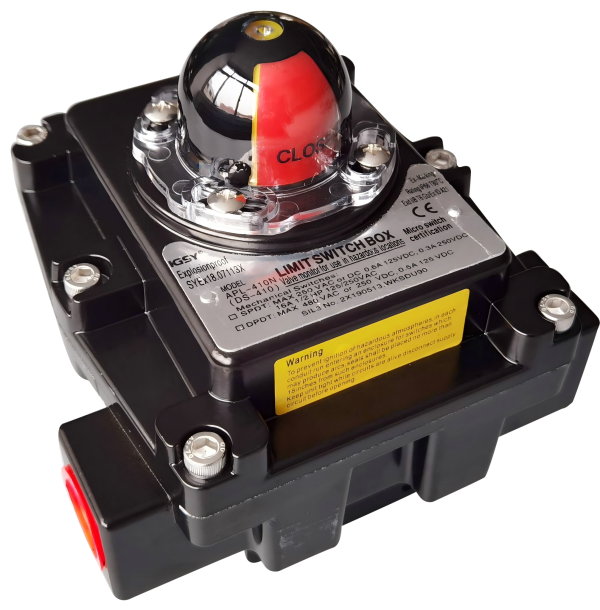
In the world of process control and industrial automation, the feedback regarding a pneumatic valve’s status is critical. As the bridge between physical hardware and the control system, a Limit Switch Box (Valve Position Monitor) converts the physical position of a valve (Open or Closed) into electrical signals via internal micro-switches.
When reviewing the technical catalog of Zhejiang KGSY Intelligent Technology Co., Ltd., engineers are often faced with a fundamental choice: Should I specify SPDT or DPDT switches? While both provide position feedback, their internal architecture, wiring complexity, and application suitability differ significantly.
This guide explores these differences within the context of KGSY’s APL, DSK, and ALS series products.
What is an SPDT Switch? (Single Pole Double Throw)
SPDT stands for Single Pole Double Throw. This is the standard and most widely used configuration in KGSY limit switch boxes, such as the APL-210N or the DSK100.
Internal Structure and Logic
An SPDT switch consists of one Common terminal (COM), one Normally Closed terminal (NC), and one Normally Open terminal (NO).
- The Action: When the valve actuator rotates, driving the KGSY “Quick-Set” cam to strike the micro-switch, the Common terminal disconnects from the NC and switches to the NO.
- Signal Output: It can send one signal (e.g., telling the PLC the valve is open) or toggle power between two different devices.
KGSY Implementation
In a standard APL-210 series box, there are typically 2 x SPDT mechanical micro-switches. One monitors the “Full Open” position, and the other monitors “Full Closed.” This satisfies over 90% of general industrial requirements while remaining compact and cost-effective.
What is a DPDT Switch? (Double Pole Double Throw)
DPDT stands for Double Pole Double Throw. In KGSY’s high-end or heavy-duty selections, such as the ALS-400 or specialized DSK200 configurations, customers can opt for this more powerful switch.
Internal Structure and Logic
Essentially, a DPDT switch functions like two independent SPDT switches housed within a single body, operated by the same mechanical lever. It features two separate Common terminals, each with its own set of NC/NO contacts.
- Simultaneity: When the cam triggers the switch, both sets of contacts flip at the exact same time.
- Isolation: The two circuits are electrically isolated. You can use one pole to send a low-voltage 24VDC PLC signal and the other pole to switch a high-voltage 220VAC local alarm lamp, without any electrical interference between the two.
Why Choose DPDT?
The primary advantage of DPDT is redundancy and multi-loop control. For critical Emergency Shutdown Valves (ESD), engineers often require a single mechanical action to trigger two independent signals to ensure that if one control loop fails, the other still provides an accurate valve position.
Technical Comparison: SPDT vs. DPDT
Based on the technical data in the KGSY selection manual, we can compare these two based on several dimensions:
1. Terminal Points and Wiring
- SPDT: In a standard KGSY design with two SPDT switches, the box usually comes with an 8-point terminal strip. This accommodates 3 wires for each switch plus 2 for the solenoid valve.
- DPDT: A box with two DPDT switches requires double the wiring. Consequently, KGSY DPDT models are often equipped with a 12-point or larger terminal strip to handle the increased feedback lines.
2. Load Capacity and Space
In KGSY’s switch options (utilizing brands like Omron V-15 or Honeywell):
- SPDT: High current loads (e.g., 15A/250VAC) are standard.
- DPDT: While maintaining high load capacity, the internal structure is more complex. DPDT switches are larger, requiring more internal clearance within the switch box housing.
3. Key Application Scenarios
| Feature | SPDT (Single Pole) | DPDT (Double Pole) |
| Typical Use | Water treatment, HVAC, general chemicals. | Power plants, Oil & Gas, Safety systems. |
| Feedback | Single signal to PLC. | Isolated signals to both DCS and local panels. |
| Complexity | Low (3 wires per switch). | High (6 wires per switch). |
| Safety | Standard. | High (Ideal for SIL3/Redundant systems). |
Selection Guidance for KGSY Products
The Economical Choice: APL-210 / DSK100 (SPDT)
If you only need a basic Open/Close signal for your control room, the APL-210 series is the best fit.
- Pros: IP67 protection, compact design, and features KGSY’s signature red/yellow “Quick-Set” cams for tool-free adjustment.
The Heavy-Duty Choice: ALS-400 / DSK200 (Available with DPDT)
For complex signal outputs or heavy industrial environments, the ALS series provides a larger housing to accommodate DPDT switches.
- Pros: Die-cast aluminum alloy with polyester coating, capable of housing up to 4 SPDT or 2 DPDT switches.
The Hazardous Area Choice: KG800-X / FC800
In explosion-proof zones, safety is paramount.
- Certifications: ATEX, IECEx, SIL3.
- Pro-Tip: For Intrinsically Safe (Ex ia) loops, KGSY recommends using Gold-Plated contacts (available in both SPDT and DPDT) to ensure conduction stability at very low voltages.
Summary: Which One Should You Choose?
The decision between SPDT and DPDT depends entirely on your system architecture:
- Single Feedback Loop? Go with SPDT. It is simple, economical, and perfectly reliable when paired with KGSY’s precision cam technology.
- Isolated Dual Signals or Redundancy? Go with DPDT. While the initial investment is higher, it provides the safety of isolated circuits and flexible electrical design.
- Space Constraints? Note that some compact KGSY boxes may not have the physical clearance for DPDT switches. Always verify with a KGSY Sales Manager (manager@zjkgsy.com) before ordering.
By selecting the correct switch configuration, you ensure that your pneumatic valves “speak” clearly to your control system under all conditions.
Get Further Technical Support:
- Website: www.chinakgsy.com
- Tel/WeChat: 086-13587661980
Address: Building 8, No. 377 Branch Road of Binhai 12 Road, Wenzhou Economic Development Zone, Zhejiang, China.
Post time: Feb-03-2026

