
In the complex architecture of industrial process automation, procurement departments are often tasked with minimizing upfront capital expenditure (CapEx). When sourcing components for automated valve packages, the limit switch box—or valve position monitor—is frequently viewed as a low-priority commodity. Driven by tight project budgets, facilities often default to the cheapest available hardware, treating a limit switch as a simple mechanical afterthought.
However, this procurement strategy represents a fundamental misunderstanding of industrial economics. The true cost of a valve position monitor is rarely found on its initial purchase order. Instead, it is measured in operational expenditure (OpEx), maintenance labor, and the catastrophic financial impact of unplanned downtime.
When a cheap limit switch box fails, the control room loses its only verification of physical reality. A single blind valve can halt an entire production line, trigger a false emergency shutdown, or ruin a multi-million-dollar hygienic batch. To maximize profitability, plant managers must shift their focus from the initial price tag to the Total Cost of Ownership (TCO).
Here is a deep dive into the economics of valve monitoring, the hidden costs of budget components, and why investing in premium engineering—such as the solutions provided by Zhejiang KGSY Intelligent Technology Co., Ltd.—yields a massive return on investment (ROI).
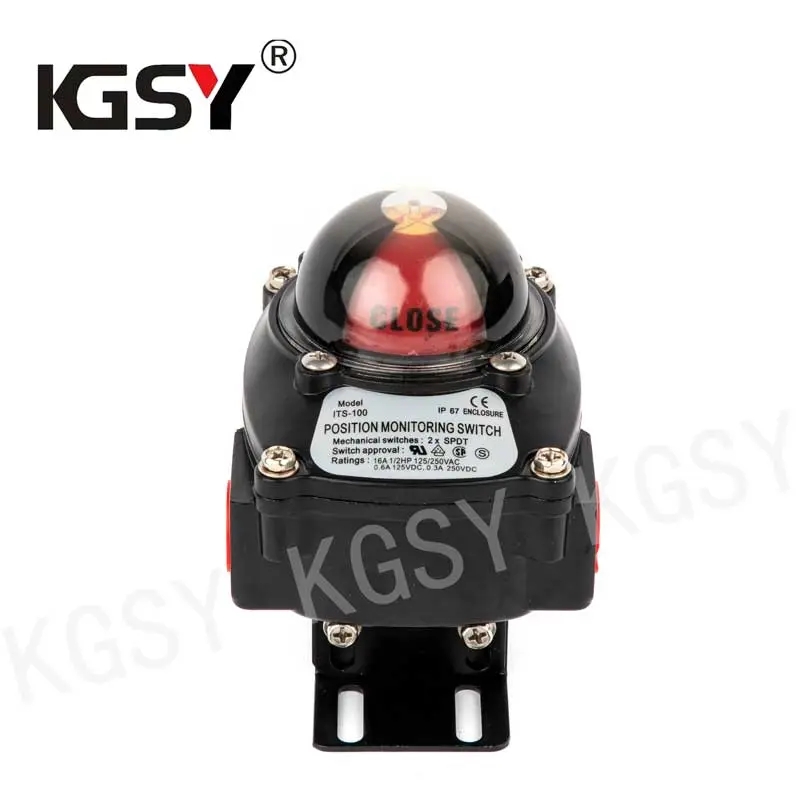
1. The Hidden Costs of Cheap Components: The “Run-to-Failure” Fallacy
Standard, general-purpose limit switch boxes are built to meet minimum viable specifications. They utilize lightweight plastics, thin aluminum housings, standard rubber seals, and internal micro-switches fastened with tiny set-screws. In a sterile, static laboratory, they perform adequately. In a high-vibration compressor station or a dusty cement plant, they are a financial liability.
The most insidious cost of cheap hardware is maintenance labor drag.
In high-vibration pipelines, standard set-screws inevitably back out. The internal cams slip, causing the switch box to send an inaccurate signal or no signal at all to the Distributed Control System (DCS). The valve itself is functioning perfectly, but the “set-screw slip” triggers a system alarm.
Maintenance teams must then scaffold up to the valve, isolate the line, open the enclosure, manually realign the cams, and recalibrate the DCS loop. If a facility has thousands of automated valves, this constant recalibration becomes a massive, recurring labor expense that silently bleeds the maintenance budget dry.
The Quality Solution: High-quality monitors completely engineer out this failure mode. For example, KGSY’s limit switch boxes utilize splined, spring-loaded quick-set cams. Once a technician pushes, turns, and releases the cam, it locks onto the splined stainless steel shaft. It is mechanically impossible for the cam to slip out of calibration, permanently eliminating this recurring labor cost.
2. The Catastrophic Cost of “Silent Failures”
In high-stakes environments like chemical refineries or offshore platforms, valves are integrated into Emergency Shutdown (ESD) Systems. These systems rely on absolute digital certainty.
A cheap switch box suffering from internal corrosion—perhaps due to a degraded IP65 seal allowing moisture to oxidize the silver contacts—creates a “Silent Failure.” The switch is dead, but the control room doesn’t know it. If an emergency pressure spike occurs and the valve jams mid-stroke, the dead switch fails to report the jam. The safety logic solver cannot trigger secondary defense layers, potentially leading to equipment destruction, environmental fines, or catastrophic safety incidents.
Even if an accident is avoided, a false signal from a failing switch box can trigger an accidental plant trip. In large-scale petrochemical processing, an unplanned shutdown can cost hundreds of thousands of dollars per hour in lost production and flared product. Spending an extra $100 on a heavy-duty, SIL-certified limit switch box with gold-plated contacts is an infinitesimally small insurance premium against a $1,000,000 shutdown.
3. Integrating for ROI: Analyzing the ITS-100 Advantage
Beyond preventing failures, modern valve monitoring economics is driven by architectural efficiency. Historically, facilities relied on the “Christmas Tree” stack: mounting a limit switch box on top of an electropneumatic positioner.
This legacy setup doubles the economic burden on the facility. It requires two separate brackets, two separate sets of wiring, dual cable runs, and double the installation time.
The ITS-100 Integrated Positioner and Monitor completely upends this economic model by merging proportional control and high-fidelity feedback into a single, low-profile enclosure. The financial impact of this integration is highly quantifiable:
- ● 40% Reduction in Labor Costs: Installing, wiring, and calibrating a traditional stacked assembly takes approximately 180 minutes per valve. Commissioning a single-point ITS-100 takes roughly 95 minutes. Multiply this time savings across a 500-valve plant expansion, and the labor reduction is staggering.
- ● 30% Savings in Wiring Infrastructure: By utilizing a unified terminal block and shared conduit entries, the ITS-100 eliminates redundant explosion-proof cable glands, armored cabling, and secondary I/O modules at the PLC.
- ● Space Optimization: The 40% reduction in instrument height allows engineers to design tighter, more efficient piping manifolds, saving valuable footprint space on offshore skids and pharmaceutical cleanrooms.
4. Lifecycle Longevity and Severe-Service Engineering
A limit switch box that costs half the price but needs to be replaced three times a decade is not a bargain. TCO calculations must account for the mechanical durability and metallurgical integrity of the housing over a 10-to-20-year lifecycle.
Upgrading to specialized hardware provides a measurable increase in operational reliability:
- ● Explosion-Proof Retrofits: Upgrading from legacy general-purpose boxes to the ALS-500 (Ex d IIC T6) series provides a 130% increase in mechanical durability, ensuring compliance with strict hazardous area safety mandates and preventing regulatory fines.
- ● Marine & Offshore: Saltwater destroys standard paint in months. By investing in IP68 submersible seals, ISO 12944 C5-M marine coatings, or 316L Stainless Steel enclosures, offshore operators avoid the massive costs of fighting galvanic corrosion and replacing water-logged electronics.
- ● Hygienic F&B Processing: In food and beverage plants, standard limit switch boxes with crevices harbor bacteria, leading to batch contamination. A single contaminated batch recall can cost millions. Investing in smooth, self-draining, IP69K-rated hygienic sensors eliminates this bio-hazard entirely.
Conclusion: Quality is Credibility
In industrial automation, you do not pay for a limit switch box; you pay for digital certainty. Every time a facility attempts to save a marginal amount of money on budget feedback devices, they exponentially increase their exposure to signal drift, maintenance fatigue, false plant trips, and safety violations.
To secure your process and your bottom line, procurement strategies must shift toward Total Cost of Ownership. By specifying hardware with splined cams, IP67/IP68 sealing, solid-state NAMUR sensors, and integrated architectures, facilities can permanently optimize their operational expenditure.
For decades, Zhejiang KGSY Intelligent Technology Co., Ltd. has engineered valve position monitors to deliver exactly this economic advantage. Whether you are upgrading to the heavy-duty ALS-500 explosion-proof series or streamlining your skids with the ITS-100 linear integrated sensor, KGSY provides the unyielding reliability required to protect your assets and maximize your process profitability.
Post time: Jun-24-2026

