
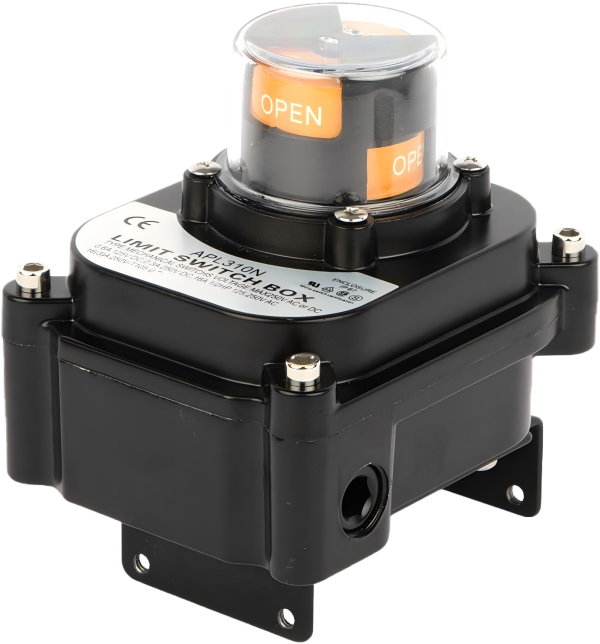
In the harsh reality of industrial processing, vibration is unavoidable. From the rhythmic thrum of a compressor skid to the violent shudder of a reciprocating pump, pneumatic valves are constantly subjected to mechanical stress.
While engineers often focus on the durability of the actuator or the seal of the valve, the most common point of failure is often the smallest: the electrical connection.
At Zhejiang KGSY Intelligent Technology Co., Ltd., we understand that a Limit Switch Box (Valve Position Monitor) is only as good as its wiring. If a wire comes loose inside the housing, the control room loses feedback, the process stops, and safety systems may be compromised. This is why the design of the Terminal Strip—specifically the use of high-retention or spring-loaded technologies—is critical for longevity.
This guide explores the physics of connection failure, the benefits of vibration-proof terminals, and how KGSY’s DSK, APL, and KG800 series are engineered to withstand the shake, rattle, and roll of heavy industry.
The “Silent Killer” of Automation: Terminal Loosening
To understand the solution, we must first understand the problem. Standard screw terminals, often found in cheaper, generic switch boxes, rely on the friction of a tightened screw to hold the copper wire against the busbar.
The Physics of Failure
In a vibration-prone environment (like a power plant or offshore rig), two forces work against this connection:
- Micro-Movement: Constant vibration causes the screw to micro-rotate or “back out” over time.
- Thermal Cycling: As current flows (or ambient temperatures change from -20°C to +60°C ), the copper wire expands and contracts. Over time, the copper “flows,” becoming thinner under the screw. When it cools, a gap forms.
The Result: Increased contact resistance, heat generation, signal jitter (false alarms), and eventually, a complete open circuit.
The Solution: Spring-Loaded (Tension-Clamp) Technology
The industry standard for overcoming vibration is the Spring-Loaded Terminal. Unlike a static screw, a spring mechanism exerts continuous, dynamic pressure on the wire.
How It Works
- Constant Tension: The spring acts as a “live” clamping mechanism. It pushes against the wire with a calculated force.
- Compensation: If the wire expands due to heat or flattens due to settling, the spring expands to fill the gap. It automatically adjusts to changes in the wire’s geometry.
- Vibration Immunity: Because the clamp is under tension, vibration cannot “unscrew” it. The connection remains gas-tight and secure, regardless of external movement.
KGSY Product Design: Engineered for Connection Integrity
At KGSY, our limit switch boxes are designed to serve industries where failure is not an option—Petroleum, Chemical, and Power Generation. Consequently, our internal architecture prioritizes secure wiring.
1. High-Density, Secure Terminal Strips
Our switch boxes, such as the DSK100 and APL-310, are equipped with generous terminal capacities.
- Standard: 8 Points. This allows for the connection of 2 limit switches (6 wires) plus 2 pass-through wires for the solenoid valve.
- Option: 12 Points. For DPDT switches or complex feedback loops.
These terminal strips are angled and positioned to allow for easy tool access while ensuring the wire is gripped firmly. The components used are selected to meet SIL3 and CE safety standards, ensuring they can handle the mechanical stress of installation and operation.
2. The “PCB + Terminal” Architecture
In our advanced models like the KG800-X Series, the terminal strips are often mounted directly onto a vibration-dampened Printed Circuit Board (PCB). This creates a solid substrate that absorbs high-frequency vibrations before they reach the wire interface, adding a second layer of protection against disconnection.
Case Study: Hazardous Areas and Explosion Proofing
The stakes for secure wiring are highest in hazardous environments. In an Explosion-Proof (Ex d) enclosure like the KGSY KG800 or FC800 Series , a loose wire is not just a nuisance—it is a spark risk.
If a wire loosens and touches the metal housing or another terminal, it can create a short circuit. While the Ex d enclosure is designed to contain an internal explosion, the goal of Intrinsic Safety (Ex ia) is to prevent the spark entirely.
KGSY’s Approach to Safety
- Certifications: Our boxes carry ATEX (II 2G Ex db IIC T6 Gb) and IECEx ratings . Achieving these certifications requires rigorous testing of internal components, including the reliability of electrical terminations under thermal stress.
- Secure Mounting: The terminal strips in our Ex-series are reinforced to ensure that even during a fault condition, wires remain captive.
Installation Best Practices for Vibration Areas
Even the best KGSY terminal strip requires proper installation to function correctly. When installing our ALS-400 or DSK200 units in high-vibration zones (like compressor outlets), follow these guidelines:
- Use Ferules: Always crimp a ferule (bootlace) onto stranded wire before inserting it into the terminal. This prevents stray strands from causing shorts and provides a solid surface for the clamping mechanism.
- Cable Glands: The terminal strip holds the wire, but the Cable Entry holds the cable. KGSY boxes offer 2 x NPT1/2″, G1/2″, or M20 entries. Use an armored cable gland that grips the cable jacket tightly. This transfers the vibration stress to the gland, not the delicate copper wires inside the terminal.
- Leave a “Service Loop”: Do not pull wires tight inside the box. Leave a small loop of excess wire. This acts as a shock absorber, decoupling the terminal connection from external cable movement.
Why Choose KGSY for Tough Environments?
When you source valve accessories from China, you need a partner who understands the difference between a “static” lab test and “dynamic” field conditions.
- Material Quality: From our Aluminum Alloy housings to our Stainless Steel 316 options , every part of a KGSY box is built for rigidity. A rigid housing reduces internal resonance, protecting the terminal strip.
- Testing: Our ISO9001 quality management system ensures that our electrical sub-components are tested for retention force and conductivity.
- Versatility: Whether you need a simple APL-210 or a heavy-duty DS500, our wiring interfaces are designed for the human hand and the industrial hammer.
Conclusion
Don’t let a ten-cent loose wire shut down a million-dollar process. By choosing KGSY limit switch boxes, you are investing in internal components engineered to hold on tight, no matter how much the pipeline shakes.
Secure your connections today.
Contact KGSY for a quote on vibration-resistant valve monitoring solutions.
- Website: www.chinakgsy.com
- Email: manager@zjkgsy.com
- Phone: 086-13587661980
Post time: Feb-11-2026

