
Troubleshooting Signal Jitter in Valve Position Monitors: Causes and Solutions
In modern process automation, a Distributed Control System (DCS) relies on absolute certainty. When a PLC sends a command to actuate a pneumatic valve, it expects a clean, instantaneous feedback signal confirming that the valve has reached its fully open or fully closed position.
However, in harsh industrial environments—where high-pressure fluids, steam, and heavy compressors are constantly operating—that certainty is often compromised by Signal Jitter.
Signal jitter (or “chatter”) occurs when the limit switch box sends a rapid, fluctuating on/off signal to the control room, rather than a solid, continuous state. This causes the DCS screen to flicker alarmingly, triggering false process interlocks, initiating unnecessary emergency shutdowns, and causing severe headaches for maintenance teams.
At Zhejiang KGSY Intelligent Technology Co., Ltd., we have engineered our valve monitoring solutions, including the KG800, FC800, and standard APL series, to eliminate these exact failure modes. If your facility is experiencing valve signal jitter, the root cause usually falls into one of four categories: mechanical vibration, contact degradation, wiring fatigue, or electrical interference.
Here is a technical guide to diagnosing and permanently resolving signal jitter in your valve automation loops.
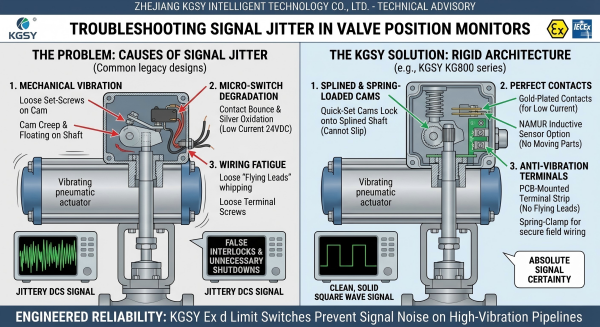
1. Mechanical Vibration and Cam Slippage
The most common cause of a jittery signal is not electrical, but mechanical. Process pipelines are inherently violent environments. The kinetic energy of fluid flow causes the pipe, the valve body, the pneumatic actuator, and the limit switch box to vibrate continuously.
The Problem: Set-Screw Creep
In lower-quality limit switch boxes, the internal cams (which physically press the micro-switches) are secured to the main shaft using tiny metal set-screws. Over months of constant pipeline vibration, these set-screws slowly back out. The cam becomes loose and begins to “float” on the shaft. When the valve closes, the cam barely grazes the switch actuator. The surrounding vibration then causes the cam to rapidly bounce on and off the switch button, sending a jittery signal to the PLC.
The KGSY Solution: Splined, Spring-Loaded Cams
To completely eliminate cam slippage, KGSY engineers discarded the set-screw design. Our limit switch boxes utilize high-precision, splined shafts paired with spring-loaded cams.
During calibration, the technician pushes the cam down against a heavy spring, rotates it to the precise actuation angle, and releases it. The internal splines lock the cam into the shaft grooves. Once set, it is mechanically impossible for the cam to slip or vibrate out of position, ensuring a solid, continuous switch actuation even on the most turbulent steam lines.
2. Micro-Switch Contact Bounce and Degradation
If the cams are securely locked, the next suspect is the micro-switch itself.
The Problem: Mechanical Fatigue and Oxidation
Mechanical switches (SPDT or DPDT) operate by physically slamming a movable metal contact against a stationary contact. Even brand-new mechanical switches experience microscopic “contact bounce” for a few milliseconds, which PLCs are usually programmed to filter out.
However, as a switch ages, the internal spring loses tension. Furthermore, if the switch is switching very low currents (like a 24VDC PLC input) using standard silver contacts, a microscopic layer of silver oxide can build up on the metal. This oxidation acts as an insulator. When the weakened spring pushes the contacts together, the connection is poor and easily disrupted by ambient vibration, resulting in severe signal jitter.
The KGSY Solution: Gold-Plated Contacts and Solid-State Upgrades
For standard mechanical switching, KGSY specifies premium, industrial-grade micro-switches with high-tension springs. If you are running low-current PLC signals (typically below 50mA), we strongly recommend specifying our boxes with Gold-Plated Contacts. Gold does not oxidize, ensuring a perfectly clean, jitter-free signal over millions of cycles.
For ultimate reliability in high-vibration zones, KGSY recommends upgrading to Inductive Proximity Sensors (NAMUR). Because these sensors are solid-state and have zero moving internal parts, they are physically immune to contact bounce and mechanical fatigue.
3. Wiring Fatigue at the Terminal Strip
A highly robust switch is useless if the wire carrying the signal is vibrating loose.
The Problem: “Flying Leads” and Loose Screws
Many legacy limit switch boxes use “flying leads”—loose wires running from the micro-switches to a cheap, floating plastic terminal block. Continuous pipeline vibration causes these loose wires to whip back and forth. Eventually, the copper wire strands break inside the insulation, or the vibration causes the terminal screw to back out. This creates an intermittent electrical connection that the PLC interprets as jitter.
The KGSY Solution: PCB Integration and Anti-Vibration Terminals
At KGSY, our philosophy is “Quality is Credibility.” We eliminate wire whip by removing the flying leads entirely.
In our premium models, the micro-switches and the terminal strip are soldered directly to a single, rigid Printed Circuit Board (PCB). The incoming field wiring connects to robust, angled terminal blocks equipped with anti-vibration clamp designs. This rigid architecture ensures that the internal electrical pathway remains solid, regardless of the mechanical shock applied to the outer enclosure.
4. Electromagnetic Interference (EMI)
If the mechanical linkages are tight, the switches are healthy, and the wiring is secure, the jitter may be an electrical ghost.
The Problem: The Antenna Effect
Limit switch wiring acts like an antenna. If the signal cables are run in the same cable tray as high-voltage power lines—or are located near Variable Frequency Drives (VFDs) and large electric motors—they can pick up Electromagnetic Interference (EMI). This high-frequency noise induces voltage spikes on the low-voltage limit switch circuit, confusing the DCS.
The KGSY Solution: Proper Grounding Architecture
Resolving EMI requires adherence to strict installation protocols.
-
Always use shielded instrumentation cable for your switch box signals.
-
Ensure the shield is grounded at one end only (usually at the DCS cabinet) to prevent ground loops.
-
Utilize the dual-grounding mechanisms built into every KGSY Ex d limit switch box. By ensuring the heavy cast-aluminum enclosure is properly bonded to the plant’s equipotential structural grid via our external stainless-steel earthing lug, you create a Faraday cage effect that shields the internal micro-switches from external electrical noise.
Summary: A Technician’s Troubleshooting Checklist
If you are facing a jittery valve signal in the field, follow this quick KGSY diagnostic sequence:
-
Check the Bracket: Is the NAMUR mounting bracket securely bolted to the actuator? A loose bracket mimics a loose cam.
-
Inspect the Cams: Open the box (ensure safe area protocols). Are the cams firmly locked onto the shaft splines?
-
The “Tug Test”: Gently tug on the wires at the terminal strip. Are any screws loose?
-
Evaluate the Switch: Is the facility using standard silver contacts for a low-current 24VDC PLC system? Consider upgrading to gold contacts or KGSY inductive sensors.
-
Check for EMI: Are high-voltage cables running parallel to your signal wires?
Conclusion
Signal jitter is not an inevitable fact of industrial automation; it is a symptom of hardware that is mismatched to its environment. By combining splined quick-set cams, PCB-mounted anti-vibration terminal strips, and the option for solid-state proximity sensing, Zhejiang KGSY Intelligent Technology Co., Ltd. provides valve feedback solutions that guarantee absolute signal integrity.
When your DCS screen says the valve is closed, KGSY hardware ensures it stays that way.
Post time: Mar-25-2026

