
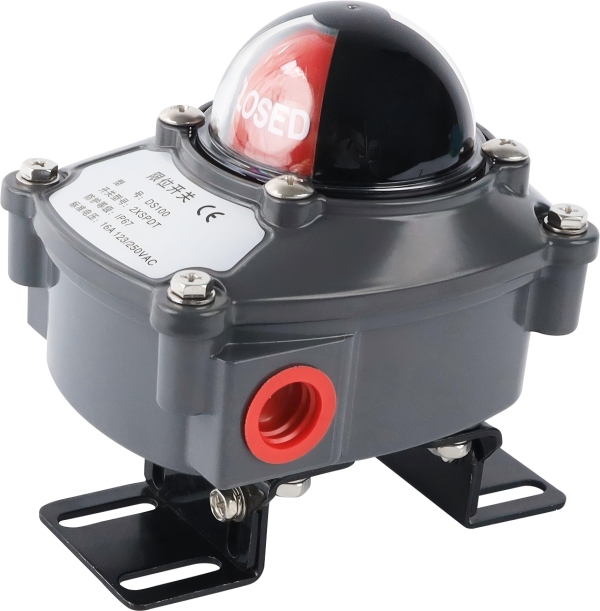
In the intricate world of industrial valve automation, precision is everything. While the pneumatic actuator provides the muscle to turn a valve, the limit switch box (valve position monitor) provides the brain, sending critical feedback signals to the control room, confirming whether a valve is fully open or fully closed.
At the heart of this feedback mechanism lies a small but vital component: the cam.
At Zhejiang KGSY Intelligent Technology Co., Ltd., we have engineered our limit switch boxes to eliminate the frustrations associated with traditional calibration. This guide explores the function of cams, compares old-fashioned fixed systems with modern adjustable designs, and explains why KGSY’s spring-loaded splined cams are the industry standard for efficiency.
What is a Cam and What Does It Do?
A limit switch box contains electrical switches (either mechanical or proximity sensors) that must be triggered at specific points in the valve’s rotation—typically at 0° (Closed) and 90° (Open).
The cam is the mechanical interface mounted on the main shaft of the switch box. As the valve actuator turns the shaft, the cams rotate. When a cam reaches a pre-set position, it physically pushes a mechanical switch lever or moves into the sensing range of a proximity sensor, completing the electrical circuit and sending a signal to your PLC or DCS.
If the cam is misaligned by even a few degrees, the control room might receive a “false open” signal, or the valve might continue to drive past its seat, causing damage. Therefore, cam calibration is the most critical step in installing a limit switch box.
The Old Standard: Fixed and Screw-Locked Cams
Historically, many limit switch boxes utilized “fixed” or “screw-locked” cams. To adjust these, a technician would need to:
- Loosen a set screw on the cam using a tiny screwdriver.
- Manually rotate the cam to the desired position, trying to hold it steady against the switch leaf.
- Retighten the screw while hoping the cam doesn’t shift.
The Disadvantages
- Tool Dependency: You cannot adjust them without specific tools. Dropping a small screwdriver into a valve assembly on an offshore rig is a major headache.
- Vibration Slippage: In high-vibration environments like power plants or pipelines, set screws can back out. Once loose, the cam slips, the signal is lost, and the system fails.
- Time-Consuming: Calibrating both the open and closed positions can take 10–20 minutes per valve.
The KGSY Solution: Spring-Loaded Splined Cams (Adjustable)
KGSY has eliminated these headaches by adopting Quick-Set Cam technology across our product lines, including the DSK100, DSK200, and APL series.
How It Works
Our cams are not held in place by friction or screws. Instead, they utilize a splined shaft (a shaft with ridges/teeth) and a matching internal spline on the cam. The cams are spring-loaded, meaning they are pushed down onto the splines by a spring force to lock them in place.
The “No-Tools” Advantage
The most significant benefit of KGSY switch boxes is that limit positions can be easily set without tools. To adjust a KGSY cam:
- Push: Simply push the cam down (or pull up, depending on the model) to compress the spring and disengage the splines.
- Turn: Rotate the cam to the exact position where it triggers the switch.
- Release: Let go of the cam. The spring snaps it back onto the splines, instantly locking it into position.
Benefits of Splined Cams
- Vibration Proof: Because the cam teeth interlock with the shaft teeth, it is mechanically impossible for the cam to slip due to vibration.
- Stability: As stated in our engineering documentation, “Once the initial setting has been done, there is no need for further adjustment”.
- Speed: Calibration takes seconds, not minutes.
KGSY Product Spotlight: Cam Technologies by Series
Different applications require different housing and switch configurations, but the convenience of our cam system remains consistent.
1. DSK Series (DSK100 / DSK200)
The DSK Series is our flagship line for standard industrial applications.
- Cam Type: Quick-set spring-loaded splined cams.
- Features: These boxes feature a double-sealed indicator that prevents water ingress even when the lid is removed for cam adjustment. This allows technicians to adjust the cams in the field without exposing the sensitive internal electronics to rain or humidity.
- Application: Ideal for water treatment and general industries.
2. APL Series (APL210 / APL310)
For cost-effective and compact solutions, the APL series provides reliable position monitoring.
- Switch Interaction: The cams in these units are designed to trigger Mechanical Switches (2 x SPDT) or Proximity Sensors.
- User-Friendly: Like the DSK series, the APL310 allows for tool-free setting via spring-loaded cams.
3. Explosion-Proof Series (KG800 / FC800 / DS Series)
In hazardous environments like Oil & Gas or Chemical plants, opening a switch box enclosure to tighten a screw is a safety risk and often requires a “hot work permit.”
+1
- The Advantage: KGSY’s Explosion-Proof Limit Switch Boxes (such as the KG800-X Series certified for Ex db IIC T6 Gb ) utilize the same quick-set cam logic. This minimizes the time the enclosure is open, significantly enhancing safety and operational efficiency.
Step-by-Step Guide: Calibrating Your KGSY Switch Box
If you are installing a KGSY DSK200 or APL310 on a pneumatic actuator, follow this simple procedure to set your position feedback:
- Mounting: Install the switch box onto the actuator using the NAMUR standard bracket (e.g., K-L01D or K-L02D). Ensure the actuator shaft engages with the switch box shaft.
+1 - Close the Valve: Actuate the valve to the fully closed position (0°).
- Adjust “Close” Cam: Open the switch box lid. Identify the bottom cam (usually Red or associated with the “Close” switch). Push the cam down against the spring, rotate it until the switch clicks (or the LED lights up), and release. It is now locked.
- Open the Valve: Actuate the valve to the fully open position (90°).
- Adjust “Open” Cam: Identify the top cam (usually Yellow/Green). Push it down, rotate until the second switch triggers, and release.
- Visual Verification: Check the Visual Position Indicator on top of the box. It should clearly show Yellow/Green for Open and Red for Close.
Conclusion: Why Upgrade to Adjustable Cams?
The “Adjustable vs. Fixed” debate is settled. Fixed cams belong to the past. Modern industrial automation demands speed, reliability, and vibration resistance.
KGSY Intelligent Technology has standardized spring-loaded splined cams across our entire range because they offer:
- Tool-Free Maintenance: No tiny screws to lose.
- Permanent Settings: Immune to vibration drift.
- Universal Application: Compatible with both mechanical switches (SPDT/DPDT) and proximity sensors (P&F, Autonics).
Whether you need a weatherproof IP67 box or an ATEX-certified explosion-proof unit, KGSY provides the intelligent control accessories that keep your plant running smoothly.
Ready to upgrade your valve monitoring?
Browse our Limit Switch Box Catalog to find the perfect fit for your actuators.
- Website: www.chinakgsy.com
- Contact: manager@zjkgsy.com
- Tel: 086-13587661980
Post time: Feb-03-2026

