
In the heavy industrial landscape, few environments are as physically punishing to instrumentation as a cement manufacturing plant. From the primary crushing of limestone to the intense heat of the rotary kiln, and finally to the bagging and shipping terminals, every stage of the process is enveloped in a dense cloud of highly abrasive, microscopic particulate matter.
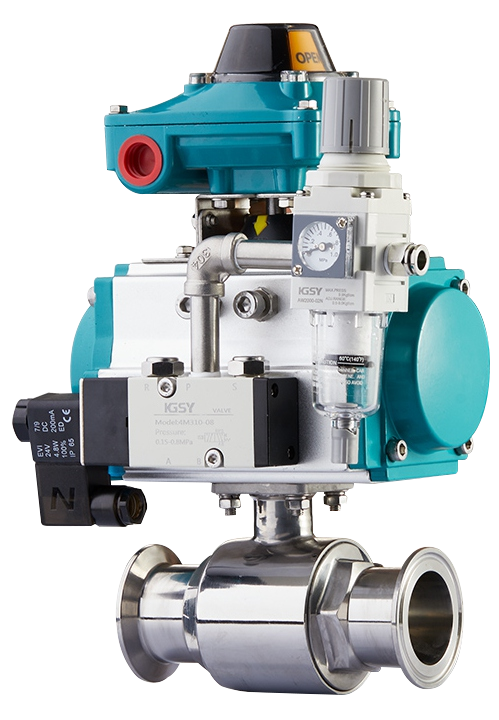
Automated valves—such as knife gates, butterfly valves, and pinch valves—are the workhorses of cement pipelines. They regulate the flow of raw meal, pulverized coal, clinker, gypsum, and finished cement. For the plant’s Distributed Control System (DCS) to operate safely, it must receive real-time, accurate feedback confirming whether these valves are open, closed, or throttling.
This feedback relies entirely on valve position monitors (limit switch boxes). However, in a cement plant, fine dust acts like liquid sandpaper. If your switch boxes are not engineered to handle severe particulate environments, they will suffer rapid mechanical and electrical failure.
This technical guide explores the destructive physics of cement dust, the engineering standards required for dust-tight protection, and how Zhejiang KGSY Intelligent Technology Co., Ltd. designs its heavy-duty position monitors to survive the world’s most abrasive processing lines.
1. The Dust Gauntlet: Why Cement Particulates are Lethal to Electronics
To understand the necessity of specialized cement-grade hardware, we must examine how cement dust interacts with mechanical and electrical components.
Abrasive Erosion
Cement raw meal and clinker dust consist of highly abrasive compounds, including silicon dioxide (), aluminum oxide (), and calcium oxide (). These particulates have a typical particle size distribution ranging from to . When these sharp, microscopic crystals settle on a rotating valve shaft, they act as an abrasive grinding paste. Over millions of valve cycles, this dust wears away at standard rubber seals, carving out paths for moisture and deeper dust ingress.
Mechanical Binding and “Set-Screw Slip”
Standard limit switch boxes often utilize tiny metal set-screws to lock the internal striking cams onto the primary shaft. In a cement plant, fine dust penetrates every unsealed crevice. It packs tightly into the threads of these set-screws. Combined with the high-frequency vibration of nearby mills and kiln drives, this packed dust exerts a wedging force that backs the screws out, causing the cams to slip on the shaft. The valve moves, but the loose cam fails to strike the switch, sending a false position signal to the control room.
Conductive and Hydrophilic Bridging
Cement dust is highly hydrophilic; it aggressively absorbs moisture from the air. If unsealed cable glands or a degraded cover gasket allow dust to enter the electrical cavity, the dust absorbs ambient humidity, forming a conductive paste across the terminal block. This paste bridges the electrical contacts, causing stray currents, signal jitter, and short circuits that can blind the DCS.
2. Ingress Protection: Why IP67 is the Absolute Baseline
In a cement plant, general-purpose enclosures are a liability. To prevent catastrophic dust ingress, engineers must specify limit switch boxes rated to at least IP67 (NEMA 4, 4X).
The Ingress Protection (IP) standard (IEC 60529) defines the performance gap required for dust defense:
- ● IP5X (Dust-Protected): Ingress of dust is not totally prevented, but it must not enter in sufficient quantity to interfere with the satisfactory operation of the equipment. (Insufficient for cement plants).
- ● IP6X (Dust-Tight): No ingress of dust; complete protection against contact. This is the mandatory baseline.
The KGSY Double-Barrier Sealing System
At KGSY, our rugged series, including the APL-310 and ALS-400 series, are designed to exceed basic IP67 requirements.
To prevent dust from wicking up the rotating shaft, we utilize a redundant dual-shaft seal featuring high-density NBR or Viton lip seals. Additionally, the housing cover features a precision-machined groove that holds a continuous, high-compression O-ring. When the captive cover bolts are tightened, the O-ring compresses evenly, creating a hermetic seal that blocks even the finest clinker dust from entering the electronics bay.
3. Engineering Out the Weak Points: KGSY’s Solution to Fine Dust
At Zhejiang KGSY, we believe that “Quality is Credibility.” We have engineered our position monitors to eliminate the specific failure modes common in cement facilities.
Splined, Spring-Loaded Quick-Set Cams
To completely eliminate the risk of “set-screw slip” caused by dust and vibration, KGSY eliminated set-screws entirely. Our APL and ALS series utilize a splined, spring-loaded cam system.
To calibrate the switches, a technician simply pushes the cam down against a heavy internal spring, rotates it to the correct angle, and releases it. The splined teeth on the cam interlock with the grooves on the stainless steel shaft. Once locked, it is mechanically impossible for the cam to slip, even if the box is subjected to continuous, high-impact pipeline vibration.
Direct PCB-Mounted Terminals
Standard switch boxes with loose “flying leads” (dangling wires running from the switch to a terminal block) are highly vulnerable to vibration fatigue and dust collection. KGSY integrates the switches and terminals onto a single, rigid Printed Circuit Board (PCB) inside the housing. This eliminates wire whip, simplifies field terminations, and keeps the electrical pathways clean and compact.
4. Solid-State Upgrades: Eliminating Contact Wear
Within a cement plant, mechanical micro-switches face a limited lifespan due to the sheer volume of operating cycles. Traditional copper springs and silver contacts can fatigue or tarnish.
For the ultimate in long-term reliability on highly critical lines—such as coal dust feed systems or kiln exhaust dampers—KGSY recommends upgrading to Inductive Proximity Sensors (NAMUR):
- ● Zero Mechanical Contact: Proximity sensors operate on electromagnetic fields. There is no physical lever, roller, or button to get jammed or worn down by abrasive dust.
- ● Hermetic Encapsulation: The internal sensor coils are completely potted in solid epoxy resin inside the switch box. Even if the cover is opened during a dusty maintenance turnaround, the sensor elements remain completely sealed and impervious to environmental contamination.
5. Critical Installation Guidelines for Cement Pipe Loops
Even the most advanced IP67-rated limit switch box will fail if the field installation is flawed. Maintenance crews must adhere to strict wiring protocols:
- ● Use Heavy-Duty Ex d or Watertight Cable Glands: Never use cheap plastic glands that degrade under UV light and crack when struck by tools. Specify heavy nickel-plated brass or stainless steel glands equipped with high-compression elastomeric seals.
- ● Seal Unused Conduit Entries: Every KGSY switch box features dual conduit entries. If only one entry is used for the signal cable, the second entry must be sealed with a certified, metal stopping plug wrapped in thread sealant. An open conduit entry is an open door for clinker dust.
- ● Incorporate Drip Loops: Always bend incoming cables into a distinct U-shape (“drip loop”) immediately before they enter the cable glands. This prevents gravity from forcing rainwater mixed with abrasive dust down the cable and past the gland seal.
Conclusion
In cement manufacturing, equipment downtime is incredibly costly. By moving away from fragile, general-purpose hardware in favor of IP67 dust-tight, splined-cam, and epoxy-coated aluminum enclosures, operators can permanently eliminate signal drift and mechanical jams from their failure logs.
At Zhejiang KGSY Intelligent Technology Co., Ltd., our APL and ALS-400 series position monitors are engineered specifically to handle the relentless dust gauntlet. By combining robust metallurgy, double-barrier lip seals, and tool-free splined cams, KGSY helps you secure your process, protect your machinery, and deliver reliable, continuous automation feedback across the cement plant.
Post time: Jun-16-2026

