
In the global procurement of industrial instrumentation, supply chain managers and project engineers often devote the entirety of their evaluations to upfront unit costs, mechanical materials, and immediate production lead times. When sourcing valve accessories—such as limit switch boxes, electropneumatic positioners, and solenoid valves—the initial transaction is frequently viewed as the finish line.
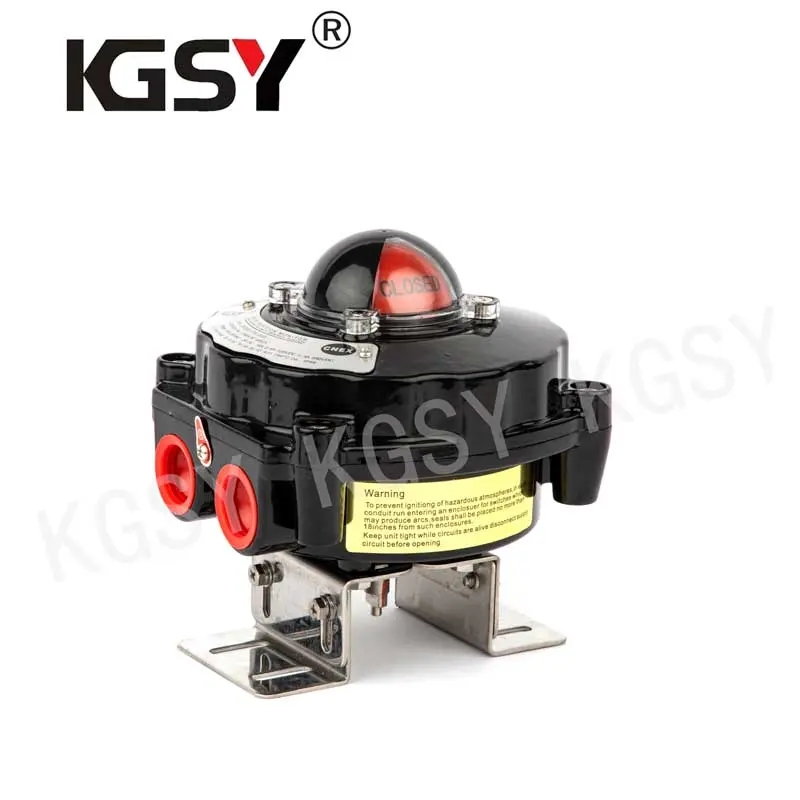
However, in the field of process automation, the physical purchase is merely the beginning of a decade-long lifecycle. Automated valve assemblies are dynamic, high-cycle systems operating under severe mechanical and environmental stress. If a critical position monitor fails in the field, the financial penalty is rarely limited to the replacement cost of the $100 accessory; it is measured in the cascading losses of unplanned plant downtime, maintenance overtime, and safety risks.
To insulate your facility from these liabilities, procurement strategies must prioritize the evaluation of a supplier’s warranty terms and after-sales technical support framework. This comprehensive guide explores what global buyers must look for when auditing a supplier’s long-term service commitments, with a focus on elite partners like Zhejiang KGSY Intelligent Technology Co., Ltd.
1. The Engineering Math of Warranties: Protecting Against “Infant Mortality”
In reliability engineering, physical components typically follow the classic “Bathtub Curve” of failure rates over time. This curve is divided into three distinct phases:
- Infant Mortality: High failure rates early in life, typically driven by microscopic material defects, manufacturing anomalies, or commissioning errors.
- Useful Life (Constant Failure Rate): Low, stable random failure rates during normal operation.
- Wear-Out Phase: Rising failure rates as materials fatigue, elastomer seals degrade, and components reach the end of their design life.
The primary mathematical purpose of a manufacturer’s warranty is to insulate the buyer from the costly Infant Mortality phase.
  Failure Rate (λ)
   ▲
   │  \  Infant              Useful Life             Wear-Out / Fatigue  /
   │   \ Mortality        (Random Failures)             (End of Life)   /
   │    \   Period                                                     /
   │     \───────────*──────────────────────────────*─────────────────/
   │                 ▲                              ▲
   └─────────────────┴──────────────────────────────┴─────────────────► Time (t)
               [ WARRANTY COVERAGE ]
The probability of a device surviving past a specific operating time $t$ during its useful life can be modeled using the exponential reliability function:
$$R(t) = e^{-\lambda t}$$
Where:
- $R(t)$ is the reliability (probability of survival).
- $\lambda$ is the constant failure rate (failures per hour).
- $t$ is the operating time.
If an imported limit switch box suffers from an undetected casting micro-porosity in its aluminum enclosure, or a cold solder joint on its internal PCB, these defects will manifest almost immediately during commissioning or within the first few months of continuous vibration. A robust, legally binding manufacturer’s warranty ensures that any device suffering from these early-life manufacturing defects is replaced or repaired immediately at zero cost to the buyer.
2. Deconstructing the Technical Warranty: What to Look for in the Fine Print
Not all warranties are created equal. When reviewing an international supplier’s datasheet or commercial agreement, procurement teams must look past basic marketing claims and analyze the specific legal and temporal structures of the contract.
The $12/18$ Industry Standard
An elite industrial supplier should offer a warranty structured as 12 months from the date of installation, or 18 months from the date of shipment (bill of lading), whichever comes first.
This dual-parameter timeline is critical for major capital projects (CapEx). When building a chemical plant, desalination facility, or oil skid, imported accessories like the APL-210 series or ALS-500 explosion-proof series may sit in a warehouse or on-site storage yard for six to nine months before being bolted to an actuator and commissioned. A warranty that only runs for 12 months from the date of shipment could expire before the plant even begins active operations.
Scope of Coverage: Exclusions vs. Inclusions
Read the warranty exemptions carefully. A quality supplier will fully cover physical defects in materials and workmanship under normal operating conditions. Look for clarity on the following points:
- Elastomeric Seals: Are the internal Viton or Silicone O-rings covered? (They should be, provided they are operated within their rated temperature limits, e.g., $-40^\circ\text{C}$ to $+120^\circ\text{C}$).
- Mechanical Wear: High-cycle components, like KGSY’s splined, spring-loaded quick-set cams, should have guaranteed mechanical alignment integrity over the life of the warranty.
- Enclosure Coating: Surface finish warranties should guarantee that the baked polyester powder coat will not peel, blister, or crack under normal atmospheric exposures (such as UV radiation or high-humidity environments).
3. After-Sales Technical Support: The Real Test of a Supplier
When a field technician is standing on a high-access scaffolding platform in the pouring rain, trying to wire a limit switch box to a safety PLC, they do not need a legal document—they need immediate, accurate technical answers.
After-sales support is the practical extension of a supplier’s quality commitment. When sourcing globally, check for these four vital support pillars:
A. Instant Access to 3D CAD Models and Documentation
During the engineering and design phase of a project, piping and instrumentation designers must build digital twins of the automated valve assemblies.
- What to Look For: A supplier must provide instant, open-access 2D and 3D CAD files (such as
.STEPor.IGSformats) for all switch boxes and brackets. This ensures that the accessory mates perfectly with the pneumatic actuator, eliminating costly field-fit modification errors. - Interactive Manuals: Clear, detailed wiring diagrams, terminal block layouts, and step-by-step calibration guides must be readily accessible online or via QR codes printed directly on the product nameplates.
B. Specialized Engineering Depth (Not Just Sales Representatives)
Many trading companies or low-tier factories only employ sales generalists who lack the technical knowledge to troubleshoot complex field issues.
- The Standard: When a technical query is raised—such as how to integrate a solid-state NAMUR proximity sensor into a low-current safety loop—the buyer should be connected directly with an instrumentation engineer. The support team must understand control loop electronics, intrinsically safe barrier wiring, and pneumatic actuator torque profiles.
C. The RMA (Return Merchandise Authorization) Process
If a device does fail in the field, the replacement process must be streamlined to prevent operational bottlenecks.
- The Audit Parameter: Ask the supplier to detail their RMA workflow. Do they require the failed unit to be shipped back across the ocean for inspection before a replacement is issued?
- The Elite Protocol: High-tier partners like Zhejiang KGSY utilize a “Photo/Video Diagnostic Verification” protocol. For verified warranty claims, the customer provides physical photos/videos of the failure mode, enabling KGSY’s engineering team to diagnose the root cause and dispatch a brand-new replacement unit immediately, bypassing lengthy international transit delays.
4. The Vendor Audit Checklist: Evaluating Warranty & Support
Before qualifying a new valve accessory supplier for your approved vendor list (AVL), run them through this technical evaluation checklist:
                  [ VENDOR QUALIFICATION AUDIT ]
                                │
        ┌───────────────────────┼───────────────────────┐
        ▼                       ▼                       ▼
  [ LEGAL TERM ]         [ ENG. STRENGTH ]       [ LOGISTIC DEPTH ]
  - Is it 12/18 months?  - 3D STEP files?        - RMA response time?
  - Are seals covered?   - Direct engineers?     - Local buffer stock?
  - Clear exclusions?    - Wiring schematics?    - Sea/Air replacement?
- Do they offer a 12/18-month warranty? Ensure CapEx storage delays will not void your coverage.
- What is their average response time for technical inquiries? Look for suppliers committed to a guaranteed 24-hour response protocol for global time zones.
- Are custom wiring diagrams and mounting bracket brackets supported? A quality supplier should easily draft custom bracket designs to mate their switch box to proprietary, non-standard actuators.
- How are critical replacement parts handled? Check if they maintain stock of replacement O-rings, micro-switches, and dome indicators ready for express air shipment.
Conclusion: Securing the Full Lifecycle of Your Assets
Procuring low-cost valve feedback devices with zero after-sales backing is a short-term savings that introduces immense long-term risk. To maximize process reliability and protect your company’s bottom line, purchasing decisions must balance the initial price against the total cost of ownership over a 10-year lifespan.
At Zhejiang KGSY Intelligent Technology Co., Ltd., we believe that “Quality is Credibility.” This philosophy extends far beyond the factory floor. From our standard APL-210 general-purpose switch boxes to our highly customized, ATEX-certified ALS-500 series, KGSY backs every device with a robust, industry-standard $12/18\text{-month}$ warranty, open-source 3D CAD modeling, direct access to instrumentation engineers, and a rapid-response RMA protocol.
When you partner with KGSY, you are not just buying a physical limit switch box—you are securing digital certainty, lifetime technical support, and the operational peace of mind your process demands.
Post time: Sep-09-2026

