
In the hazardous atmospheres of oil refineries, chemical plants, and offshore rigs, the smallest electrical spark can lead to a catastrophic event. Because valve limit switch boxes contain electrical components—micro-switches, sensors, and terminal strips—they are potential ignition sources. To mitigate this risk, engineers specify “Flameproof” (Ex d) enclosures.
At KGSY, our explosion-proof series, including the KG800 and FC800, are engineered to meet stringent global standards such as ATEX and IECEx. But what exactly does “Flameproof” mean in the context of valve automation?
This guide explains the engineering principles of Ex d protection, the importance of the “Flame Path,” and how KGSY products ensure the safety of your facility.
1. The Core Principle: Containment, Not Exclusion
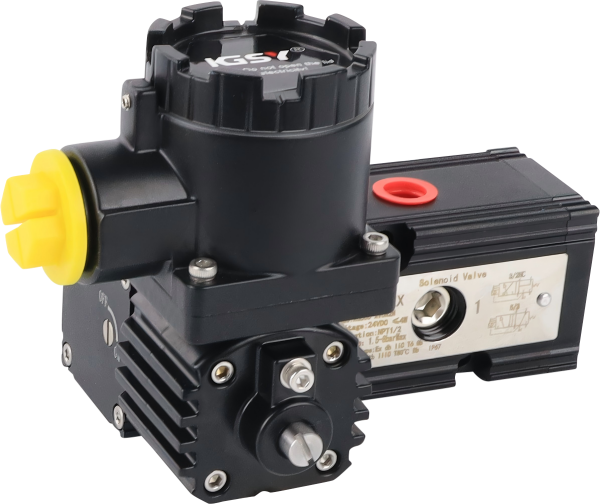
A common misconception is that a flameproof enclosure is “airtight” to keep explosive gases out. This is actually the principle of a different protection method (Ex p – Purging).
Flameproof (Ex d) protection works on the principle of Containment. The international standard (IEC 60079-1) defines it as an enclosure that can:
-
Withstand an internal explosion of the gas or vapor that may enter it.
-
Prevent the transmission of the explosion to the explosive gas atmosphere surrounding the enclosure.
In simple terms: If a spark inside your KGSY KG800 switch box ignites an accumulated gas mixture, the box is strong enough to keep the explosion inside and cool the escaping gases so they cannot ignite the outside air.
2. The Engineering Secret: The “Flame Path”
The most critical feature of a flameproof limit switch box is the Flame Path. This is the precisely engineered gap between the mating surfaces of the enclosure (such as where the cover meets the body or where the shaft exits the housing).
How the Flame Path Works
When an internal explosion occurs, the resulting hot gases are forced out through these gaps. As the gas travels through the long, narrow flame path, it loses heat energy through thermal transfer to the heavy metal walls of the enclosure.
-
By the time the gas reaches the outside atmosphere, its temperature is below the ignition point of the surrounding hazardous gases.
-
KGSY Engineering: Our FC800 and KG800 series utilize threaded and flanged flame paths that are machined to tolerances of a fraction of a millimeter to ensure this cooling effect.
3. Materials and Construction: Why KGSY Uses Heavy-Duty Alloys
Because a flameproof box must survive internal pressure without deforming, material choice is paramount.
Die-Cast Aluminum Alloy (Copper-Free)
Our standard explosion-proof boxes, like the ALS-500, are made from high-strength, copper-free aluminum alloy.
-
Advantage: Lightweight yet incredibly strong.
-
Surface Treatment: We apply a chromate conversion coating followed by a polyester powder coat to prevent corrosion, ensuring the flame path surfaces remain pristine over decades of service.
Stainless Steel 316
For extreme environments (offshore platforms or highly corrosive chemical lines), we offer the KG800-SS.
-
Advantage: Superior mechanical strength and resistance to salt-air corrosion. Stainless steel is less likely to suffer from “pitting” which could compromise the flame path gap.
4. Key Components of a KGSY Flameproof Switch Box
A KGSY Ex d box is more than just a thick shell; it is a system of safety features:
High-Strength Fasteners
Look at the cover of a KG800 series box. You will see heavy-duty stainless steel socket head cap screws. These are designed to hold the cover in place against the massive internal pressure of a gas ignition. Never replace these with standard bolts.
The Threaded Cable Entry
KGSY boxes feature NPT 1/2″ or M20x1.5 threaded entries. In a flameproof system, the cable gland must also be flameproof (Ex d). The threads themselves act as a spiral flame path, cooling gases as they attempt to escape through the wiring conduit.
The Rotary Shaft Seal
The shaft that connects the actuator to the internal cams must rotate freely but remain flameproof. KGSY uses a specialized cylindrical flame path around the shaft, often protected by an additional oil seal to keep out dust and moisture (IP67/IP68).
5. Decoding the Marks: Understanding Ex db IIC T6 Gb
If you look at the nameplate of a KGSY box, you will see a string of symbols. Here is what they mean for your safety:
-
Ex db: The protection method (Flameproof).
-
IIC: The Gas Group. “IIC” is the most stringent category, covering the most volatile gases like Hydrogen and Acetylene. This means a KGSY IIC box is safe for almost any gas environment.
-
T6: The Temperature Class. This ensures the external surface of the box will never exceed 85°C, preventing auto-ignition of surrounding gases.
-
Gb: Equipment Protection Level (EPL). “Gb” indicates a “high” level of protection, suitable for Zone 1 and Zone 2 hazardous areas.
6. Maintenance: The “Do’s and Don’ts” of Ex d Boxes
The longevity and safety of a flameproof box depend on proper handling. Because the flame path is so precise, even a small scratch can make the box dangerous.
-
Do Not Paint the Flame Path: If you are repainting the valve assembly, ensure no paint gets on the mating surfaces of the cover and body. Paint creates a gap that can allow flames to escape.
-
Inspect for Scratches: During maintenance, if you drop the cover and scratch the flange, the unit may need to be replaced.
-
Grease is Good: Use only KGSY-approved non-setting grease on the flame paths to prevent corrosion and water ingress while maintaining the cooling properties of the gap.
-
Tighten All Bolts: A flameproof box with a missing or loose bolt is no longer flameproof.
7. Conclusion: Quality is Credibility
At Zhejiang KGSY Intelligent Technology Co., Ltd., we take the word “Flameproof” seriously. Our KG800 and FC800 series are not just enclosures; they are life-saving pieces of engineering. By combining robust materials like copper-free aluminum and SS316 with precision-machined flame paths, we provide a product that allows your facility to operate safely in the most volatile conditions.
When you see the KGSY logo on an explosion-proof box, you are seeing a commitment to international safety standards and mechanical excellence.
Does your project require ATEX or IECEx certified feedback? Contact our technical team for the full certification dossiers and CAD drawings for our Ex d series.
-
Website: www.chinakgsy.com
-
Email: manager@zjkgsy.com
-
Phone/WeChat: 086-13587661980
Post time: Mar-04-2026

