
In the industrial automation sector, the reliability of a system is often determined by its smallest components. While massive pneumatic actuators and heavy-duty valves do the physical work, the limit switch box (valve position monitor) acts as the nervous system, sending critical feedback to the Distributed Control System (DCS) or Programmable Logic Controller (PLC).
When a plant operator commands a valve to close, they rely entirely on the signal from the limit switch to confirm the action. If that signal fails, the consequences can range from production downtime to catastrophic safety hazards.
At Zhejiang KGSY Intelligent Technology Co., Ltd., we offer a wide range of limit switch configurations, from standard SPDT mechanical switches to advanced Intrinsically Safe (Ex ia) sensors . One of the most critical decisions engineers must make when specifying these boxes is the choice of contact material: Silver vs. Gold.
This guide explores the physics of switch failure, the “Dry Circuit” phenomenon, and why gold-plated contacts are often the mandatory choice for modern, low-voltage automation systems like those supported by our DSK, APL, and KG800 series.
The “Silver Standard” and Its Limitations
Traditionally, mechanical micro switches (like the V52 OMRON or V1E Honeywell options available in our catalog ) use silver or silver-alloy contacts. Silver is an excellent conductor and is relatively inexpensive.
How Silver Works (The Cleaning Arc)
When a switch carrying a standard industrial load (e.g., 110VAC or 220VAC at several Amps) opens or closes, a tiny electrical arc is generated just before the contacts touch. This arc is hot enough to burn off any oxidation or tarnish that has formed on the silver surface. This natural “self-cleaning” process keeps the switch reliable over its service life.
The Problem: Low Voltage and Oxidation
However, silver has a weakness: it tarnishes. It reacts with sulfur and oxygen in the atmosphere to form silver sulfide and silver oxide. This tarnish acts as an insulator.
In modern automation, we rarely use high voltage for signaling anymore. Most systems operate on 24VDC or even lower logic levels (5V-12V) with very low currents (milli-amps).
- The Result: At these low energy levels, there is no electrical arc. The energy is too weak to burn through the layer of silver tarnish.
- The Failure Mode: The switch mechanically closes, but the electrical signal cannot pass through the corrosion layer. The control room sees “Open” when the valve is “Closed.” This is known as a Dry Circuit failure.
The Gold Solution: Reliability at Logic Levels
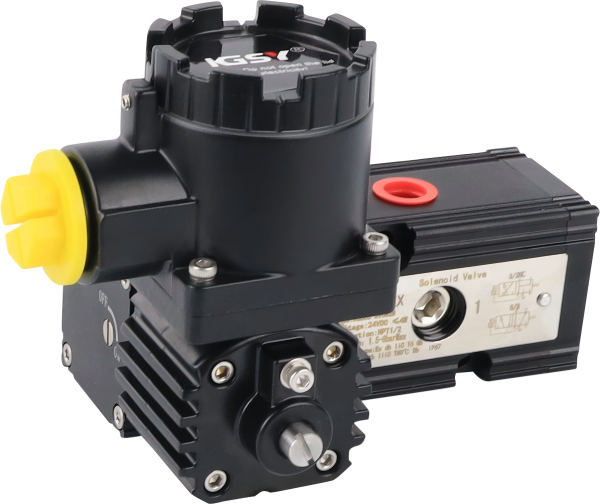
Gold is a noble metal. It does not react with oxygen or sulfur, meaning it never tarnishes or corrodes. A gold-plated contact remains conductively pure even after sitting idle for months in a humid environment.
Why Gold is Essential for KGSY Applications
For specific KGSY switch box configurations, gold contacts are not just a luxury; they are an engineering necessity.
1. 24VDC PLC Integration
As indicated in our technical specifications, our limit switch boxes frequently interface with systems running at ≤100mA 12-24VDC. In these 24VDC PLC circuits, the current is often below the “wetting current” threshold required to clean silver contacts. Gold-plated contacts ensure that even at these low energy levels, the signal is transmitted instantly and reliably every time the cam triggers the switch.
2. Intrinsically Safe (Ex ia) Environments
KGSY specializes in explosion-proof solutions, such as the KG800 and FC800 Series, which carry ATEX, IECEx, and SIL3 certifications . In Intrinsically Safe (Ex ia) applications (e.g., using P&F NJ2 sensors or Ex ia mechanical switches ), the system is deliberately designed to limit electrical energy to prevent sparks that could ignite explosive gases.
+1
- The Conflict: You cannot have a “cleaning arc” in an explosive environment.
- The Solution: Gold contacts provide a reliable connection without requiring the thermal energy of an arc, making them the only viable mechanical option for Ex ia zones.
3. Infrequent Operation (The “Safety Valve” Scenario)
Many KGSY limit switch boxes are installed on Emergency Shutdown (ESD) valves. These valves may remain in one position for months or years, only moving during a test or a real emergency.
During this inactivity, silver contacts can develop a thick layer of oxidation. When the emergency finally happens, a silver switch might fail to signal. Gold contacts are immune to time-based degradation, ensuring the signal works when it matters most.
KGSY Product Spotlight: Housing and Contact Protection
While gold plating protects the contact surface, the environment inside the switch box also plays a role. KGSY employs multiple layers of protection to ensure contact integrity.
IP67 and IP68 Weatherproof Enclosures
Moisture accelerates corrosion. KGSY limit switch boxes, such as the DSK series and KG800 series, feature strictly sealed enclosures rated IP66, IP67, and even IP68.
- O-Ring Seals: We utilize high-quality seals on the cover and shaft to prevent moisture ingress.
- Double Sealed Indicators: Our designs (like the DSK100) feature a double-sealed indicator that prevents water ingress even if the visual indicator lid is damaged or removed for maintenance. This keeps the internal micro switches dry, further protecting the contacts (whether gold or silver) from environmental corrosion.
Switch Variety
We offer a flexible range of switching options to match your budget and technical requirements :
- Mechanical (SPDT/DPDT): Available in standard silver for high voltage or gold-plated for low voltage.
- Proximity Sensors: For applications where no physical contact is desired, we offer inductive sensors like P&F NBB3, which eliminate contact wear entirely.
Selection Guide: When to Specify Gold
When ordering your KGSY Valve Position Monitor, use this checklist to determine if you need gold-plated contacts:
- Check the Voltage: Is the system voltage 24VDC or lower? If yes -> Gold.
- Check the Current: Is the load current below 100mA? If yes -> Gold.
- Check the Environment: Is this a Hazardous Area requiring Intrinsic Safety (Ex ia)? If yes -> Gold.
- Check the Frequency: Will the valve operate less than once per week? If yes -> Gold is safer.
- Standard Industrial: Is it a standard 110VAC/220VAC circuit? If yes -> Silver is sufficient and cost-effective.
Technical Specifications & Wiring
Integrating KGSY switches into your control system is straightforward. Our boxes come with versatile Terminal Strips (Standard 8 points, optional 12 points) to accommodate various wiring protocols.
Mechanical Switch Ratings (Typical)
- High Voltage (Silver): 16A at 125/250VAC. High capacity for direct control of lamps or relays.
- Low Voltage (Gold): Optimized for ranges like 0.1A at 24VDC or resistive loads as low as 1mA.
Cable Entries
To further protect your contacts, ensure you use the correct cable glands. KGSY boxes offer multiple entry standards including 2 x G1/2″, NPT1/2″, or M20, allowing for a sealed, gas-tight connection that keeps corrosive industrial atmosphere away from your switch contacts.
Conclusion: The Cost of Reliability
The price difference between a standard silver-contact switch and a gold-plated one is negligible compared to the cost of a single unscheduled plant shutdown.
At KGSY, we believe in “Quality is Credibility”. By offering gold-plated contact options within our CE, SIL3, and ATEX certified enclosures, we provide the assurance that your automation system will “hear” every signal your valves send—whether it’s today, or five years from now.
Don’t let a $5 switch stop a million-dollar process.
Contact the KGSY engineering team today to discuss the right switch configuration for your specific voltage and environmental requirements.
- Website: www.chinakgsy.com
- Email: manager@zjkgsy.com
Phone/WeChat: 086-13587661980
Post time: Feb-03-2026

