
When designing automated valve packages for hazardous locations—such as oil refineries, petrochemical plants, and offshore platforms—engineers spend a great deal of time discussing mechanical safety. We meticulously verify the ATEX and IECEx certifications of flameproof enclosures, examine the precision of machined flame paths, and specify chemical-resistant O-rings.
However, one of the most critical safety features of a KGSY Limit Switch Box has nothing to do with containing an explosion. It has to do with preventing the spark from happening in the first place.
That feature is Grounding (or Earthing).
In a Zone 1 or Zone 2 hazardous environment, a missing or improperly installed ground wire can render a multi-thousand-dollar Ex d (Flameproof) enclosure completely unsafe. This guide explores the physics of why limit switch boxes must be grounded, the difference between internal and external grounding, and how Zhejiang KGSY Intelligent Technology Co., Ltd. engineers our equipment for fail-safe compliance.
1. The Invisible Threat: Why Do We Ground?
In residential wiring, grounding protects humans from electric shock. In hazardous industrial environments, grounding protects the entire facility from catastrophic explosions. There are two primary electrical threats that grounding mitigates:
Threat A: The Ground Fault (Short Circuit)
A limit switch box like the KGSY KG800 houses electrical circuits—whether they are 24VDC NAMUR sensors or 220VAC mechanical micro-switches. Over time, due to severe vibration from the process line, a wire’s insulation may chafe and expose bare copper.
If this live wire touches the inside of the metal limit switch enclosure, the entire aluminum or stainless-steel box becomes electrically energized.
-
Without Grounding: The box sits there fully charged. If an operator touches it, they become the path to the ground, resulting in a lethal shock. Even worse, if a metal wrench touches the charged box and a nearby structural beam, it will create a massive, high-energy spark right in the middle of a flammable gas atmosphere.
-
With Grounding: The fault current immediately travels down the low-resistance ground wire to the earth, safely tripping the circuit breaker in the control room and de-energizing the system before a spark can occur.
Threat B: Static Electricity (Triboelectric Charging)
Even if your wiring is perfect, your valve is still at risk. As fluids or gases (especially dry gases or refined hydrocarbons) rush through a pipeline at high velocities, the friction generates static electricity.
This static charge migrates from the pipe, up the metal valve body, through the actuator, and directly into the limit switch box housing. If the enclosure is isolated and not grounded, this static voltage can build up to thousands of volts. Eventually, the voltage will get so high that it “jumps” through the air to a nearby uncharged object, creating an electrostatic discharge (ESD) spark. In an atmosphere containing Hydrogen (IIC) or Ethylene (IIB), this tiny static spark holds more than enough energy to cause ignition.
2. Equipotential Bonding: The Core Strategy
The ultimate goal of grounding in a hazardous area is to achieve Equipotential Bonding.
This means that every single piece of metal in the plant—the pipes, the valves, the actuators, the structural steel, and the limit switch boxes—must be at the exact same electrical potential (Zero Volts). If two objects are at the exact same voltage potential, it is physically impossible for a spark to jump between them.
By connecting your KGSY Limit Switch Box to the facility’s grounding grid, you ensure it never develops a voltage differential relative to its surroundings.
3. Internal vs. External Grounding: Understanding the Difference
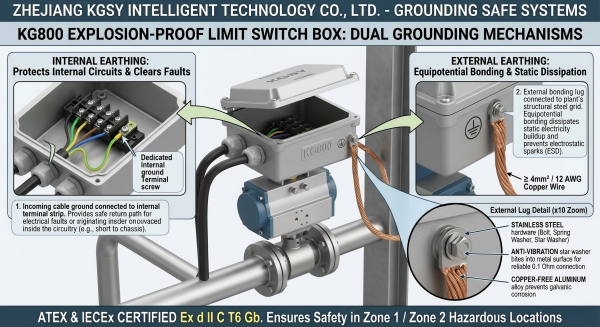
If you look closely at a KGSY explosion-proof limit switch box, you will notice it does not just have one grounding point; it has two. Global standards like IEC 60079-0 mandate both internal and external earthing facilities.
Internal Grounding
-
Location: Inside the enclosure, usually integrated into the terminal strip or as a dedicated green/yellow screw on the base plate.
-
Function: This connects the ground wire from your incoming multi-core instrument cable to the internal chassis of the box. It provides a safe return path for electrical faults originating inside the electrical circuit (e.g., a shorted micro-switch).
External Grounding
-
Location: On the outside of the KGSY housing, typically near the cable entries. It features a heavy-duty screw, a locking washer, and a deeply cast or laser-etched standard ground symbol (⏚).
-
Function: This requires a separate, thick copper wire (typically minimum 4mm² or 12 AWG) connected directly to the plant’s structural steel grid. This is the primary defense against static buildup and external lightning strikes.
An inspector will look for both. Relying solely on the internal ground wire running back to the PLC cabinet is often considered insufficient for equipotential bonding in highly volatile zones.
4. How KGSY Engineers for Reliable Grounding
At KGSY, we know that a grounding point is only effective if it maintains a connection of less than 0.1 Ohms of resistance over decades of harsh environmental exposure.
Here is how we engineer the grounding points on our KG800 and FC800 series:
-
Stainless Steel Hardware: We exclusively use SS304 or SS316 screws and washers for our external grounding points. Standard galvanized steel will rust in an offshore or chemical environment, creating an insulating layer of iron oxide that ruins the electrical connection.
-
Anti-Vibration Design: Valves vibrate. A loose ground screw is a useless ground screw. KGSY utilizes specialized spring washers and star washers (toothed lock washers) that bite into the metal, ensuring the connection remains tight and maintains electrical continuity regardless of pipeline chatter.
-
Copper-Free Aluminum: Our standard Ex d housings are cast from high-strength, copper-free aluminum alloy. This prevents galvanic corrosion (bimetallic corrosion) when a copper grounding lug is bolted to the aluminum housing, ensuring the connection point doesn’t degrade over time.
5. Best Practices for Installation in the Field
Even the best-engineered switch box can fail if improperly installed. When deploying KGSY equipment, ensure your electrical contractors follow these rules:
-
Beware of Paint: Paint is an electrical insulator. If the maintenance team repaints the valve and actuator assembly, they must not paint over the external ground lug. If the KGSY box is painted at the factory, the specific grounding pad is masked off or designed to allow the star washer to bite through the coating to the bare metal beneath.
-
Use the Right Wire: Never use a thin, fragile wire for the external ground. Use a robust, braided copper wire capable of handling high fault currents and physical abuse.
-
Keep it Short: The external grounding wire should be as short and direct as possible, connecting the KGSY box to the nearest verified grounding busbar or bonded structural steel.
-
Annual Testing: Grounding connections degrade over time due to weather and vibration. A continuous continuity test (using an intrinsically safe ohmmeter) should be part of the annual preventative maintenance schedule.
Conclusion: A Silent Guardian
Grounding is not glamorous. It doesn’t provide visual feedback like a 3D dome indicator, and it doesn’t communicate with the control room like a NAMUR sensor. It is a silent, invisible safety net. But in the explosive atmospheres of the process industry, it is the fundamental baseline of safety.
At Zhejiang KGSY Intelligent Technology Co., Ltd., our commitment to safety is built into the very casting of our products. From the precisely threaded internal terminals to the heavy-duty external bonding lugs, our limit switch boxes are designed to integrate seamlessly and safely into your facility’s equipotential grounding grid.
Are you updating your plant’s safety specifications? Ensure your valve feedback systems meet the latest ATEX and IECEx grounding requirements. Contact our engineering team for detailed CAD drawings and installation manuals for our explosion-proof series.
-
Website: www.chinakgsy.com
-
Email: manager@zjkgsy.com
-
Phone/WeChat: 086-13587661980
Post time: Mar-18-2026

