
In the world of industrial valve automation, the limit switch box (or valve position monitor) is often treated as an afterthought—a simple accessory bolted to the top of a pneumatic actuator. However, to a plant’s Distributed Control System (DCS) or Safety Instrumented System (SIS), this device is the final arbiter of truth. It is the only component that provides absolute, real-time verification that a critical valve has successfully opened or closed.
When a limit switch box fails, the control room goes blind. In a cement plant, this might lead to a jammed silo. In an offshore oil rig or a chemical refinery, a false signal from an Emergency Shutdown (ESD) valve can lead to catastrophic environmental and safety incidents.
To prevent these costly failures, engineers must look past basic dimensions and dig into the technical specifications. If you are sourcing valve position monitors for your facility, here are the 5 most critical things to check on a limit switch box datasheet before buying.
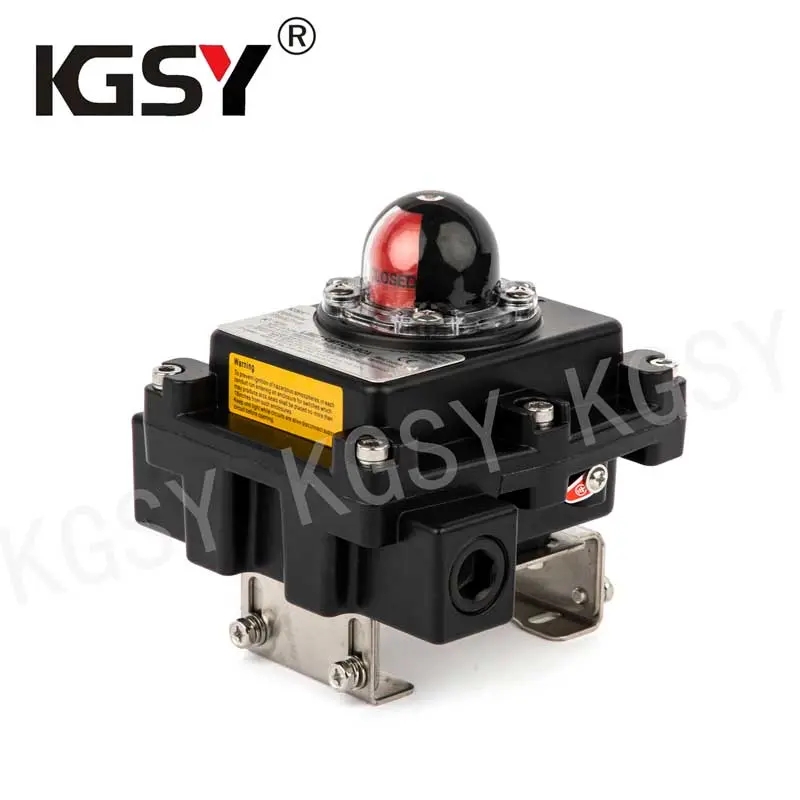
1. Ingress Protection (IP Rating): Does it Match the Reality of Your Plant?
The most common cause of limit switch failure is environmental ingress—water, moisture, or dust breaching the electrical cavity and destroying the internal micro-switches or Printed Circuit Boards (PCBs).
When reviewing a datasheet, never settle for a generic “weatherproof” label. Look strictly at the Ingress Protection (IP) rating defined by the IEC 60529 standard.
-
Avoid IP65: This only protects against low-pressure water jets and is insufficient for heavy industrial washdowns.
-
The IP67 Baseline: For standard plants (like cement or basic manufacturing), IP67 is the absolute minimum. It guarantees the box is entirely dust-tight and can survive temporary immersion in water up to 1 meter deep for 30 minutes. Look for datasheets that specify redundant dual-shaft seals and high-compression O-rings.
-
The IP68 Requirement: If your application is offshore, marine, or in an area prone to deep flooding, you must specify IP68. This ensures the enclosure can survive continuous submersion under pressure. Ensure the datasheet specifies the elastomer material—premium Viton (FKM) or FDA-compliant Silicone is highly preferred over standard Nitrile, which degrades under UV exposure.
2. Hazardous Area Certifications: General Purpose vs. Explosion-Proof (Ex d)
Installing the wrong limit switch box in a volatile environment is a severe safety and compliance violation. You must cross-reference the limit switch box’s certification with your plant’s hazardous area classification.
-
General Purpose: Suitable for safe zones (e.g., water treatment, standard food and beverage lines). Devices like the standard APL-210 series fall into this category.
-
Explosion-Proof / Flameproof (Ex d): If the valve is located in Zone 1 or Zone 2 areas (where flammable gases, vapors, or combustible dusts are present), the datasheet must explicitly state ATEX, IECEx, or UL certifications for flameproof enclosures.
Look for designations like Ex d IIC T6. This means the enclosure (like the heavy-duty KGSY ALS-500 or KG800 series) is physically engineered as a pressure vessel. It features thick die-cast aluminum or stainless steel walls and precision-machined “flame paths” designed to contain any internal electrical spark and prevent it from igniting the explosive atmosphere outside the box.
3. Internal Switching Technology: Mechanical Contacts vs. Solid State
The method used to send the electrical signal back to the PLC drastically affects the lifecycle of the unit. The datasheet will list the switch options available; you must choose the one tailored to your load and environment.
-
Standard Mechanical Micro-Switches (Silver Contacts): Great for high-current applications (e.g., 250VAC @ 16A). However, they are highly vulnerable in low-current ESD loops. If a valve sits static for years, silver contacts can build up a microscopic layer of oxide. A low-voltage DCS input (24VDC, < 10mA) cannot punch through this oxide, resulting in a false “open circuit” signal.
-
Gold-Plated Contacts: If you are using mechanical switches in a low-voltage safety loop, check the datasheet to ensure the contacts are gold-plated. Gold does not oxidize, ensuring electrical continuity even after decades of static inactivity.
-
NAMUR Inductive Proximity Sensors: For ultimate reliability in high-cycle or high-vibration environments, look for solid-state NAMUR sensors. These have zero moving parts, no physical levers to jam, and the sensor coils are hermetically encapsulated in epoxy resin, making them completely immune to moisture and wear.
4. Enclosure Metallurgy and Surface Coating
An IP67 or IP68 seal is only as effective as the metal housing holding it together. If the housing corrodes, pits, or warps, the seal will collapse.
-
Standard Environments: Die-cast aluminum with a standard polyester powder coating is sufficient for most indoor or mild outdoor applications.
-
Marine and Highly Corrosive Environments: If the box is exposed to coastal salt spray or aggressive chemical washdowns, standard paint will blister within months. Look for datasheets specifying a C5-M ISO 12944 marine-grade coating. This involves a multi-layer process of chromation, epoxy primer, and baked polyester topcoat.
-
Extreme Severe Service: For splash zones on offshore rigs, or highly acidic food and beverage (CIP/SIP) pipelines, bypass coatings entirely and look for enclosures fabricated from 316L Stainless Steel. The addition of molybdenum in 316L provides near-total immunity to chloride-induced pitting.
5. Mechanical Calibration Design: Splined Cams vs. Set Screws
This is the most frequently overlooked detail on a limit switch box datasheet, yet it causes the most daily headaches for maintenance teams.
Inside the box, the main shaft rotates a set of cams that strike the micro-switches. Traditionally, these plastic cams are fastened to the metal shaft using tiny metal set screws. In pipelines with high-frequency vibration (like compressor lines or cement mills), the vibration slowly backs the set screws out. The cam slips, the valve moves, but the switch never registers the movement—a phenomenon known as “set-screw slip.”
When reviewing a datasheet, look for the phrase “Splined, Spring-Loaded Quick-Set Cams.” Modern, high-quality valve position monitors have engineered out set screws entirely. Instead, the cams feature interlocking splined teeth. A technician simply pushes the cam down against a heavy spring, rotates it to the precise angle, and releases it to lock it onto the splined shaft. Once locked, it is mechanically impossible for the cam to drift out of calibration, regardless of pipeline vibration.
Conclusion: Securing Your Final Line of Defense
A limit switch box might represent a tiny fraction of your overall valve automation budget, but its role in plant safety, process efficiency, and DCS reliability is monumental. By scrutinizing the datasheet for strict IP ratings, appropriate hazardous area certifications, gold-plated or solid-state switching, robust metallurgy, and vibration-proof cam designs, you can permanently eliminate blind spots from your control room.
For decades, Zhejiang KGSY Intelligent Technology Co., Ltd. has engineered valve position monitors to meet these exact, uncompromising standards. From the IP67-rated APL general-purpose series to the SIL-certified, Ex d flameproof ALS and KG series, KGSY provides the digital certainty your automated processes demand.
Before you purchase your next batch of valve feedback devices, compare your datasheets against these five pillars of reliability, and ensure your facility is protected by the best.
Post time: Jun-24-2026

