
In the world of aseptic processing—spanning pharmaceuticals, biotechnology, and high-purity food production—the diaphragm valve is the undisputed king. Its ability to provide a hermetic seal, self-draining geometry, and a cavity-free design makes it essential for maintaining sterile environments. However, while the valves themselves have reached a high state of perfection, the systems used to monitor and control them have historically lagged behind.
Traditionally, automating a linear diaphragm valve was a cumbersome, “stacked” affair. Engineers had to rely on complex rotary-to-linear conversion kits to adapt standard limit switch boxes to linear stems. This approach introduced mechanical play, increased the footprint, and complicated maintenance.
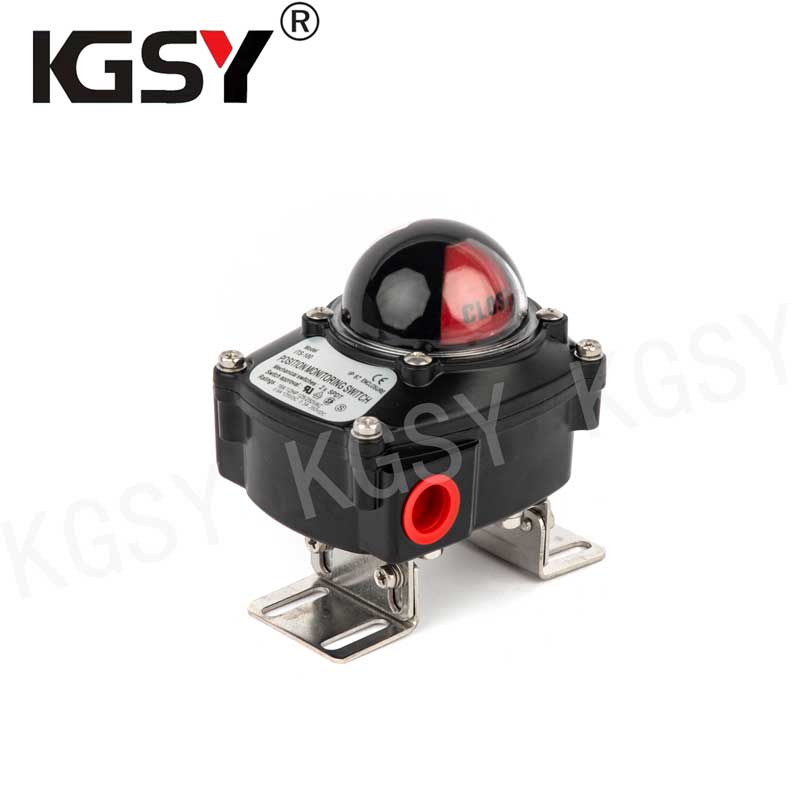
Enter the ITS-100 Integrated Linear Valve Sensor by Zhejiang KGSY Intelligent Technology Co., Ltd. By eliminating the need for conversion kits and integrating control and feedback into a single, direct-sensing unit, the ITS-100 is fundamentally changing how hygienic facilities operate.
Here is a deep dive into why this technology is a “game changer” for the industry.
1. Solving the “Linear-to-Rotary” Dilemma
Diaphragm valves move in a linear motion, often with a very short stroke—sometimes as little as 5mm to 30mm. Standard valve monitors are rotary, designed for 90-degree actuators. To make them work together, a mechanical “bridge” (a lever or linkage kit) is required to translate the stem’s up-and-down movement into a 90-degree turn.
The Problem with Conversion Kits:
-
Mechanical Hysteresis (Backlash): Every pivot point in a linkage kit introduces a tiny amount of “play.” In a short-stroke valve, a 1mm error due to backlash can represent 10% of the total stroke, leading to inaccurate DCS readings.
-
Vibration Sensitivity: These kits are often flimsy. In high-vibration environments, the linkage can shake loose, causing “signal jitter” or total feedback failure.
-
Calibration Nightmares: Setting the “Open” and “Closed” positions on a conversion kit is a tedious, trial-and-error process for field technicians.
The ITS-100 Advantage:
The ITS-100 utilizes direct linear sensing technology. There is no conversion kit. The sensor is coupled directly to the valve stem. This eliminates hysteresis entirely, ensuring that the signal sent to the control room is a perfect, real-time reflection of the valve’s physical state.
2. Maximizing Space in High-Density Skids
In modern pharmaceutical and biotech “skid” design, space is the most expensive commodity. Piping manifolds are packed tightly to minimize dead legs and reduce the overall footprint of the facility.
When you stack a traditional positioner, a conversion kit, and a limit switch box on a valve, you create a “Christmas Tree” effect—a tall, bulky instrument stack that requires significant clearance.
The ITS-100 offers a 40% reduction in instrument height. Because the feedback and control mechanisms are housed in a single low-profile enclosure, piping designers can pack valves closer together. This allows for:
-
More compact bioprocessing skids.
-
Easier access for manual maintenance.
-
Lower risk of accidental damage from staff moving through tight piping galleys.
3. Drastic Reduction in Wiring and Installation Costs
Installation labor and materials often exceed the cost of the hardware itself. In a traditional setup, a technician must pull a cable for the control signal and a separate cable for the feedback signal. This means two conduit runs, two sets of cable glands, and double the termination labor.
The ITS-100 is an integrated solution. It manages both the control and the monitoring functions through a single, unified electrical interface.
-
Consolidated Cabling: Pull one cable to the valve instead of three.
-
Fewer Ingress Points: Every cable entry is a potential path for moisture. By reducing the number of entries, the ITS-100 inherently improves the long-term reliability of the electrical loop.
-
Faster Commissioning: Technicians only need to open one cover to wire the entire loop, significantly accelerating plant startup schedules.
4. Built for Hygienic and Aseptic Environments
Hygienic valves are subject to aggressive Clean-in-Place (CIP) and Steam-in-Place (SIP) cycles. They are blasted with high-pressure caustic chemicals and scorched with saturated steam.
If a valve monitor isn’t built to the same standards as the valve, it will fail. The ITS-100 is engineered with a focus on Sanitary Integrity:
-
IP67/IP68 Protection: Completely sealed against high-pressure washdowns.
-
Non-Porous Materials: Available in heavy-duty polyester powder-coated aluminum or 316L stainless steel. These finishes prevent the accumulation of bacteria and withstand the corrosive nature of cleaning agents like NaOH.
-
Smooth Contours: The enclosure design is intentionally smooth to allow for easy self-draining during washdowns, matching the hygienic philosophy of the diaphragm valve itself.
5. The “Set-and-Forget” Calibration System
One of the most praised features of the ITS-100 series is the Quick-Set cam system. In traditional units, adjusting the “trip points” for the switches involves tiny set-screws that are easily lost or stripped.
KGSY’s ITS-100 uses a splined, spring-loaded cam architecture. To calibrate:
-
A technician simply pushes the cam down to disengage the splines.
-
Rotates it to the desired position.
-
Releases it to lock it into the splines.
This process is tool-free and takes seconds. More importantly, because the cams are splined rather than held by friction screws, they cannot slip. Once the valve is calibrated, it stays calibrated, even under the stress of millions of cycles and intense pipeline vibration.
6. Real-Time Diagnostics and 4-20mA Feedback
While many diaphragm valves only need simple “Open/Closed” feedback, critical processes—such as chromatography or filtration—require more granular data.
The ITS-100 can be equipped with a 4-20mA position transmitter. This allows the DCS to track the valve’s exact position (e.g., 15% open, 82% open) rather than just the end-of-stroke limits. This is a game changer for throttling applications where precise flow control is required through a linear diaphragm valve.
7. Total Cost of Ownership (TCO)
When analyzing the ITS-100, engineers must look beyond the initial purchase price. The Total Cost of Ownership is significantly lower than traditional setups due to:
-
Reduced CapEx: Lower costs for brackets, wiring, and conduit.
-
Reduced OpEx: Fewer maintenance interventions, no recalibration required, and faster replacement times.
-
Increased Uptime: Higher resistance to vibration and moisture means fewer unplanned shutdowns.
Conclusion: Engineering the Future of Linear Control
The ITS-100 Integrated Linear Valve Sensor is more than just a component; it is a solution to a decades-old engineering inefficiency. By removing the complexity of conversion kits, shrinking the hardware footprint, and simplifying the electrical infrastructure, it allows pharmaceutical, food, and chemical plants to operate with higher precision and lower risk.
For engineers looking to modernize their facility and embrace the standards of Industry 4.0, the ITS-100 represents the perfect balance of rugged industrial engineering and high-fidelity digital feedback.
Master your linear control. Protect your sterile process. Choose the ITS-100.
Post time: May-27-2026

